
Third-Party Risk Management Software

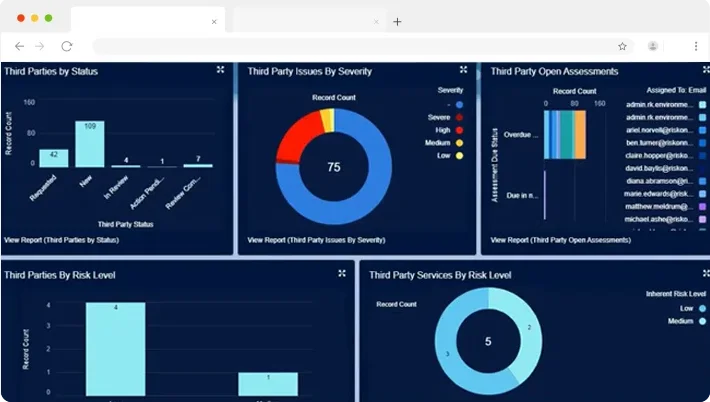
Riskonnect’s Third-Party Risk Management software consolidates all vendor and supplier information to minimize your exposure and maximize your benefits throughout the entire relationship.

Choose vendors with confidence. Know the facts about a vendor’s security status, financial strength, and level of risk before onboarding them to your company.

Build third-party relationships based on trust. Engage your partners in frank, productive conversations around your standards and expectations.

Keep important documentation ready-to-go. Rest assured that documentation and data are always updated and available when you need it.
Third-Party Risk Management Software

Third-Party Risk Management Software

Product Highlights
  • Assessments
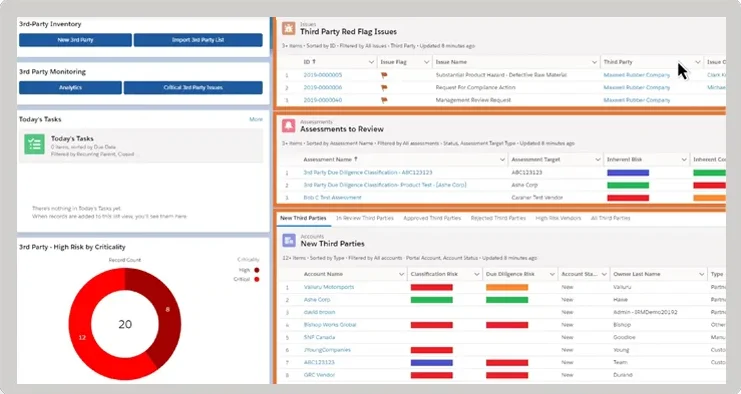
    Automatically reassess vendors according to your own schedule – and get alerts if anything is out of compliance.
  • Certificate Management
    Track agreements, contracts, policies, and access credentials to reduce exposure from third parties.
  • Dashboards
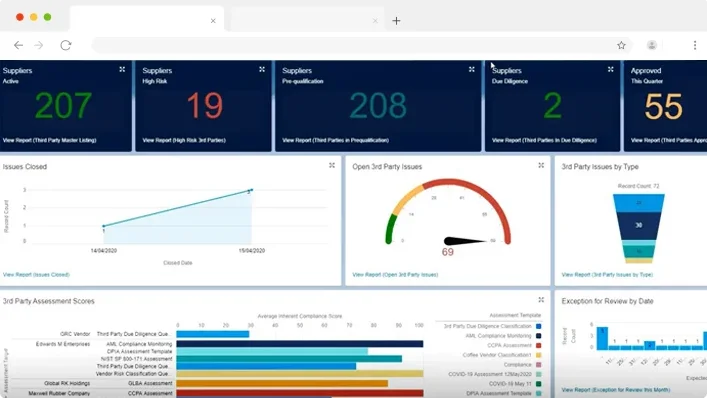
    Communicate vendor status quickly and effectively.
  • Onboarding
    Accelerate the onboarding process with a dedicated portal and customized questionnaires.
  • Risk Analytics
    and Insights
    Easily customize your reporting and dashboards to tell your story and inform decisions.Learn more.
  • Risk Rating
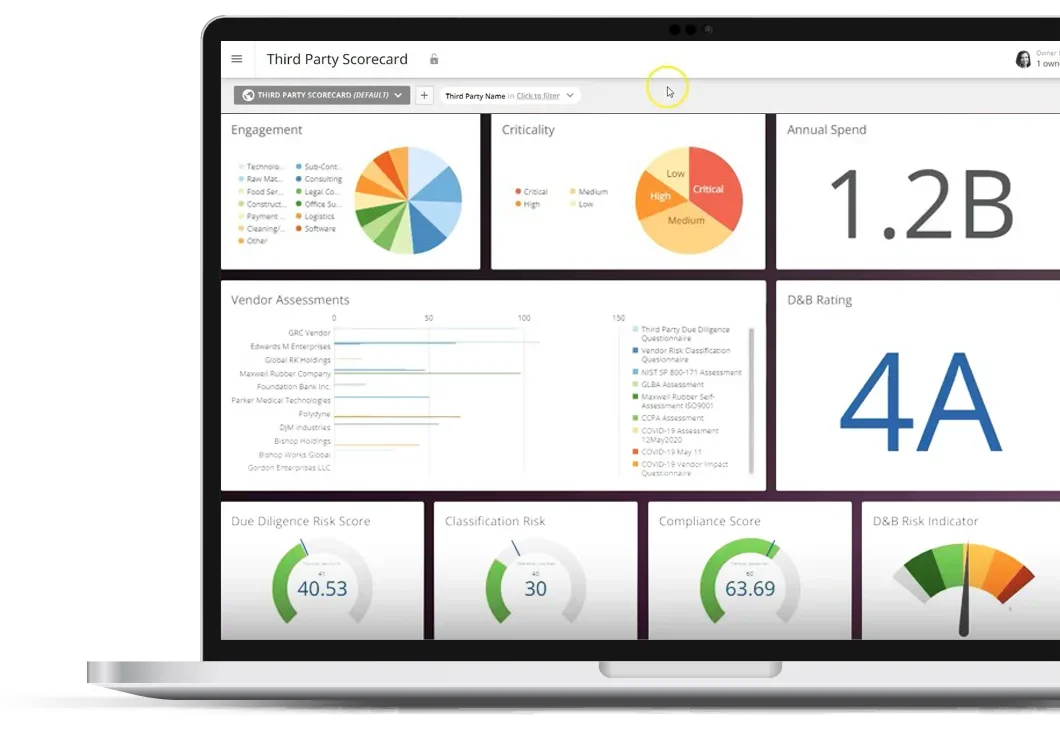
    Calculate a risk score and overall classification for each third party to identify your riskiest vendors.

TPRM Demo Video


Because of Riskonnect, we were able to move forward with a new piece of business. We were able to expand operations team revenue growth – and increase vendor compliance. Onboarding is a very seamless process for our team and for our vendors.

Workers’ Compensation Manager, Stanley Steemer

Free Up Time for

More Important Things

How can you understand your level of vendor risk if you spend all day sending and coding assessments? Riskonnect’s Third-Party Risk Management software is designed to take manual tasks off your plate, so you can focus your time on more important things like building relationships.

  • Automate workflows to save time and improve reliability.
  • Quickly onboard new vendors.
  • Turn around supplier assessments much faster, at a lower cost.
  • Easily communicate vendor risk profiles with clear, real-time reporting.
  • Better prepare for third-party churn and offboarding.
Increase
Visibility to Risk

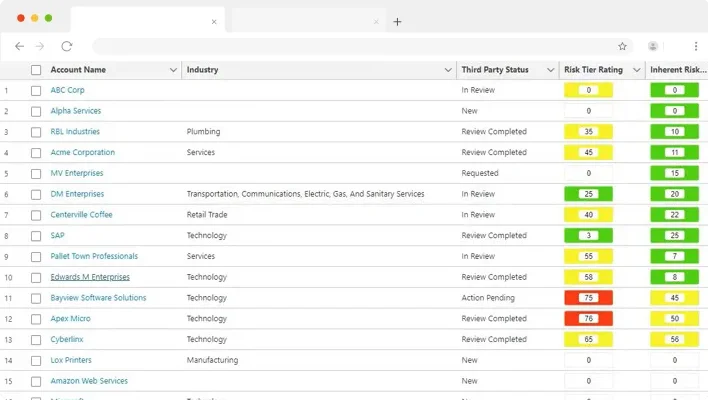
How can you build a clear picture of third-party risk when assessments and documentation are inconsistent or missing? Riskonnect’s Third-Party Risk Management software gives you the ability to track relationships from beginning to end, giving you instant insights to understand the full story.

  • Get agreements, contracts, policies, and credentials all in one place.
  • Calculate risk scores for each supplier and automatically set reassessments.
  • Be audit-ready with easy-to-access third-party documentation.
  • Elevate your assessments with insight into your suppliers’ risk.

Build Trusting

Relationships

How well do you know and trust your vendors? Riskonnect’s Third-Party Risk Management software helps you establish strong, two-way communication with your vendors to build successful relationships based on mutual respect and a shared purpose.

  • Make fact-finding easy with consistent, coordinated supplier assessments.
  • Chat with suppliers in-app to get answers and check status.
  • Gain the appreciation of suppliers with our easy-to-use portal for submitting documentation.
Tell Your Story
with Confidence

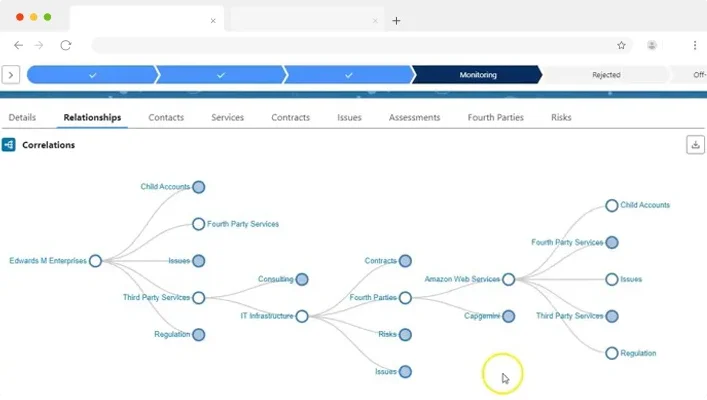
How can you build a clear picture of third-party risk when assessments and documentation are inconsistent or missing? Riskonnect’s Third-Party Risk Management software gives you the ability to track relationships from beginning to end, giving you instant insights to understand the full story.

  • Get agreements, contracts, policies, and credentials all in one place.
  • Calculate risk scores for each supplier and automatically set reassessments.
  • Be audit-ready with easy-to-access third-party documentation.
  • Elevate your assessments with insight into your suppliers’ risk.

Get Started with These Helpful Resources

EBOOK
Preparing for a Change
in TPRM Technology
This OCEG playbook, sponsored by Riskonnect, will help you understand what currently works with the way third-party risks are managed and what doesn’t to set yourself up for a successful change in third-party risk management software.
Risk management software buying guide
EBOOK
The Complete Guide to Buying
Risk Management Software
This guide demystifies the buying process with step-by-step navigation through the entire journey.
RFP TEMPLATE
Starting an RFP process for third-party risk management software?
Download Riskonnect’s list of the most critical TPRM-related questions and customize it to suit your needs.

Customers with Enhanced

Third-Party Risk Management Programs Also Use

Enterprise
Risk Management
Combine insurable and noninsurable risks so you can anticipate, assess, mitigate, and monitor every threat from every corner of the organization.
Compliance
Aggregate all corporate and legal policies, procedures, and requirements from across the organization into one centralized location.
IT Risk Management
Identify your top IT, cyber, operational resilience, and other technology risks to minimize the financial impact.

Start anywhere. Expand everywhere.

Industry Recognition for Riskonnect

Redhand Advisors Forrester Wheelhouse Advisor

Start partnering with Riskonnect today.
Find out how Riskonnect can transform the way you view risk.

Quick Answers to Your Third-Party Risk Management Questions

Third-party risk management software is a tool to protect your organization from third-party missteps. It streamlines and automates tracking and monitoring of third parties so you can quickly identify high-risk suppliers, collaborate on assessments, and focus your time on more strategic activities.

Riskonnect’s Third-Party Risk Management software offers a variety of specialized features and functions – like assessments, certificate management, and onboarding – to minimize your exposure to third-party risk so you can maximize the advantages.

Vendors and other third parties are critical to the success of many organizations – but they also pose considerable risk. Any risk – IT security, financial, supply chain – becomes your own. And the more vendors you have, the harder it is to keep tabs on it all. One sign that it’s time to consider third-party risk management software is if you work with a large number of suppliers. Another indicator that you need TPRM software is if you are struggling to collect relevant data or find important documentation about your suppliers. And if leaders are regularly asking for reports and insights that are difficult or impossible to produce, third-party risk management software may be exactly what you need.

Look for third-party risk management software that is easy to use, accessible, reliable, and secure. You should be able to easily make changes, create customized vendor questionnaires, build reports, and seamlessly communicate with suppliers without ever leaving the platform.

Riskonnect is designed to seamlessly connect risk data of all types across your organization. We also offer APIs (application programming interface) to easily import and export data and out-of-the-box integrations with specialized partners to help you get the most from your data as efficiently as possible.

Pricing depends on the size and complexity of the project and how much customization you require. We offer three industry-leading implementation options at different price points to fit your budget, while achieving your business objectives as quickly as possible.

Third-party risk management is the process of identifying, assessing, and mitigating risks that arise from an organization’s relationships with vendors, suppliers, contractors, and other external partners. Any third party with access to your systems, data, or operations introduces potential exposure — whether financial, operational, reputational, or related to cybersecurity and regulatory compliance. A structured TPRM program establishes consistent processes for due diligence before onboarding, ongoing monitoring throughout the relationship, and clear offboarding protocols when a relationship ends. For a deeper look at what TPRM entails, see What is Third-Party Risk Management?

Third-party risk comes in several distinct forms, and a mature TPRM program accounts for all of them. Cybersecurity and data security risk is often the most visible — a vendor with weak controls can become an entry point for a breach into your own systems. Operational risk arises when a supplier failure disrupts your ability to deliver products or services. Financial risk involves a vendor’s solvency and stability. Reputational risk emerges when a partner’s conduct reflects on your brand. Compliance risk occurs when a vendor’s practices put your organization out of alignment with industry regulations or contractual obligations. Understanding the specific risk profile of each vendor relationship is the foundation of effective third-party risk management.

The most effective third-party risk management platforms share a common set of capabilities: automated vendor risk assessment workflows that eliminate manual data collection; continuous monitoring that surfaces changes to a vendor’s risk posture in real time rather than only at scheduled intervals; risk scoring and tiering that helps teams prioritize attention on the highest-risk relationships; a centralized document repository for contracts, certifications, and compliance evidence; customizable questionnaires for vendor onboarding and reassessment; and audit-ready reporting that can be produced quickly without relying on IT. Integration with your broader GRC framework — connecting vendor risk data to compliance, IT risk, and enterprise risk programs — is also a strong indicator of a mature, scalable TPRM platform.

Continuous monitoring means your TPRM software tracks changes in vendor risk on an ongoing basis rather than waiting for the next scheduled assessment cycle. This can include automated alerts when a vendor’s risk score crosses a threshold, notifications when certifications or contracts expire, and updates triggered by changes in a vendor’s compliance status or external risk signals. The practical value is that you’re not relying on an annual questionnaire to tell you something has gone wrong — you’re notified in time to respond. Riskonnect’s platform is built to support this kind of real-time visibility, so risk teams can act on current data rather than information that may already be months out of date.

A thorough vendor risk assessment typically follows a consistent sequence: first, categorize the vendor by the type of access they have and the criticality of the services they provide. Second, send a risk questionnaire tailored to that vendor tier — covering cybersecurity controls, financial stability, data handling practices, and relevant regulatory compliance. Third, validate the responses by reviewing supporting documentation such as SOC 2 reports, insurance certificates, and audit results. Fourth, calculate a risk score based on findings and assign the vendor to a risk tier. Fifth, define any required remediation actions and confirm the vendor’s agreement to address gaps. Finally, set a reassessment schedule calibrated to the vendor’s risk level — higher-risk vendors warrant more frequent review. TPRM software automates and tracks each step so nothing falls through the cracks.

Regulators across industries increasingly hold organizations accountable for the actions of their vendors. In financial services, frameworks like DORA (Digital Operational Resilience Act) and guidance from the OCC require financial institutions to maintain rigorous oversight of third-party arrangements. In healthcare, HIPAA obligations extend to business associates who handle protected health information. Across sectors, data protection regulations like GDPR impose requirements on how personal data is shared with and processed by third parties. A TPRM platform creates the documentation and audit trails needed to demonstrate compliance — and makes it possible to identify and close gaps before a regulatory review surfaces them. Without structured third-party compliance software, organizations often can’t produce the evidence regulators expect. For perspective on how the stakes have risen, see Time to Put Third-Party Risk Management First.

Vendor risk management (VRM) is a subset of TPRM focused specifically on the risks associated with suppliers of goods and services. Third-party risk management is a broader discipline that encompasses vendors but also includes contractors, consultants, outsourced service providers, joint venture partners, and any other external party with access to your systems, facilities, or data. In practice, many organizations use the terms interchangeably — but a comprehensive TPRM program is designed to cover the full spectrum of external relationships, not just traditional procurement vendor relationships.

Third-party risk doesn’t exist in isolation — a vendor with a cybersecurity vulnerability is also an IT risk; a supplier out of compliance with a regulation is also a compliance risk. The most effective TPRM implementations connect vendor risk data to the organization’s broader GRC framework so that risk teams, compliance professionals, and IT security teams are working from the same information. Riskonnect is built as an integrated risk platform, meaning data flows between TPRM, IT risk management, compliance, and enterprise risk programs — giving leadership a consolidated view rather than siloed reports from disconnected tools. This integration is what separates a genuine risk management platform from a standalone third-party risk management tool.

Successful TPRM implementations share several common practices. Start by defining a clear policy that establishes what constitutes a third party, how vendors are tiered by risk, and who owns accountability for each relationship. Build a centralized inventory of all third-party relationships before attempting to assess them — you can’t manage what you haven’t identified. Use a risk-based approach to prioritize assessment depth: not every vendor warrants the same level of scrutiny, and over-assessing low-risk vendors wastes capacity that should go toward high-risk ones. Establish a cadence for reassessment that reflects each vendor’s risk tier and ensure reassessments are automated rather than calendar-dependent. Finally, treat vendor relationships as two-way: the organizations with the strongest TPRM programs treat due diligence as a foundation for building trust, not just a compliance exercise. For more on what a strong program looks like in practice, see What Makes a Strong Third-Party Risk Management Program?

When evaluating 3rd party risk management software, the most important factors are ease of configuration, depth of automation, and how well the platform fits into your existing risk management ecosystem. Specific questions worth asking: Can non-technical users build and modify questionnaires, workflows, and reports without IT involvement? Does the platform support continuous monitoring or only periodic reassessment? How does it handle vendor offboarding and the documentation lifecycle? What implementation support is provided, and how long does a typical deployment take? How does it connect to your compliance, IT risk, and enterprise risk management programs? The answers will quickly separate platforms that are built for real-world risk operations from those that look strong in a demo but create friction in practice. Riskonnect’s TPRM RFP template is a practical starting point for structuring that evaluation — and understanding what to ask third-party risk management companies before you commit. For more on navigating the risks that make this decision urgent, see Third-Party Mayhem.