
Policy Administration Software

Riskonnect’s Policy Administration software helps you manage the insurance policy lifecycle, from inception through renewals.

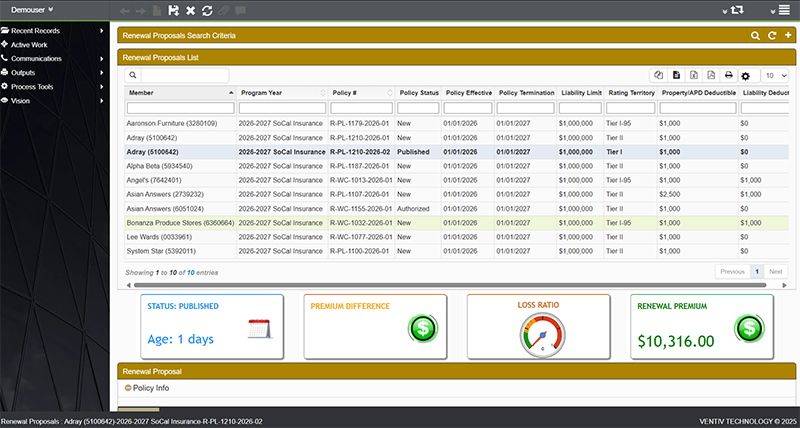
Improve risk assessment for more accurate pricing. Create operational savings with embedded analysis of premiums, risks, and deductibles.

Deliver a better customer experience. Provide brokers, agents, and insured with self-service access to policy information and reports.

Easily configure new products and workflows. Streamline product design and automate labor-intensive underwriting tasks.
policy administration software

Policy Administration Software

Product Highlights

  • Anomaly
    Detection
    Identify outliers for under/over insurance and potential premium leakage.
  • Certificate
    Management
    Easily request certificates of insurance and track expiration dates.
  • Loss Control
    Identify factors that prevent or mitigate losses.
  • Omnichannel
    Digital Portal
    Facilitate self-service transactions with a mobile-enabled portal.
  • Premium Audit
    Streamline the premium audit process by automatically verifying class codes, payroll, and other important data.
  • Product
    Configuration
    Configure workflows and business rules to support policy processes.
  • Reporting
    & Analytics
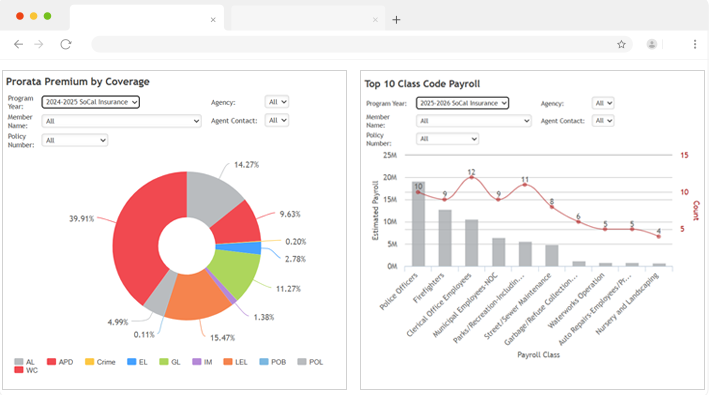
    Easily customize your reporting and dashboards to tell your story and inform decisions. Learn More.


Eliminating manual processes was a key proposition for deploying our member portal. Riskonnect helped save time for our users, reduce costs, and become more flexible in responding to member inquiries.

Amy Linder, Municipal Association of South Carolina

Empower Underwriters

at Every Step

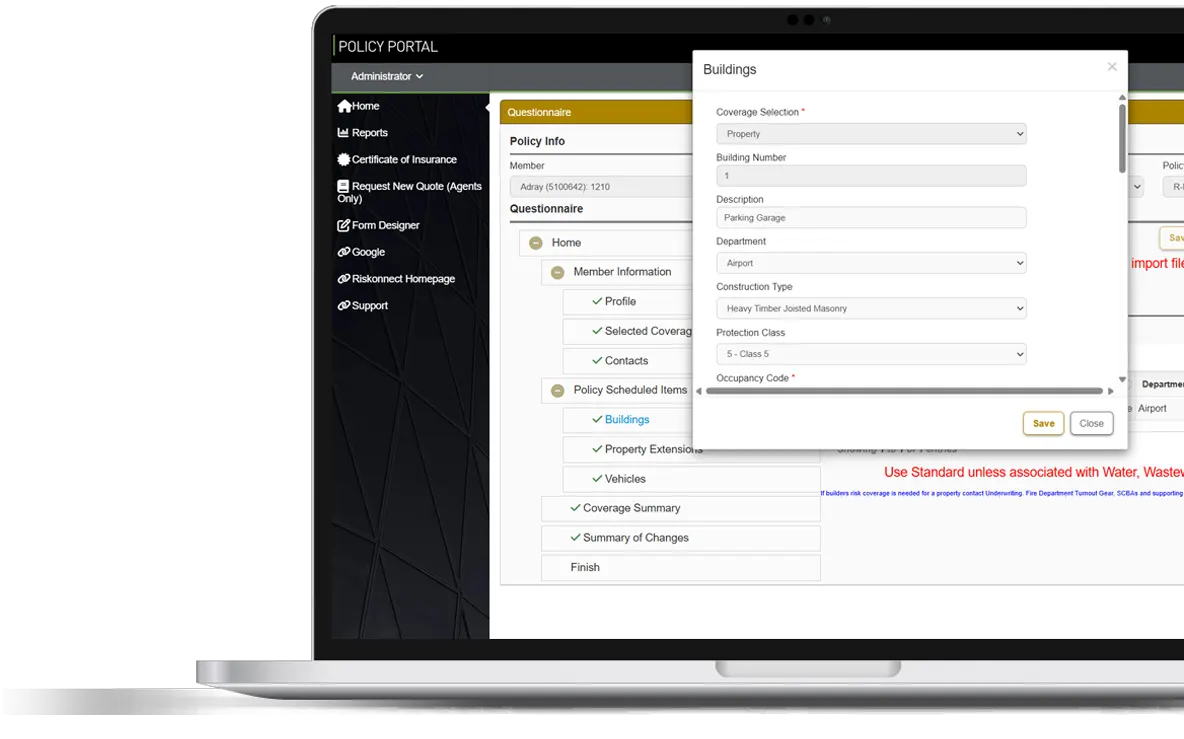
Are underwriters frustrated by the time it takes to find what they need? Riskonnect’s Policy Administration software is accessible and intuitive – which means fewer data errors and greater productivity.

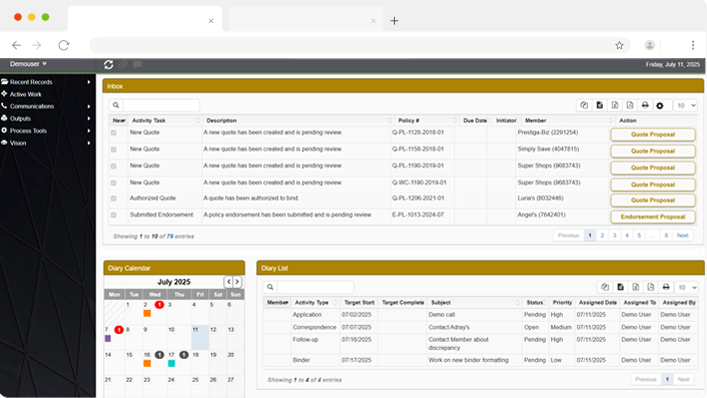
  • Help underwriters quickly respond to customer and agent inquiries with instant access to all policy information.
  • Give underwriters better insight into risks with integrated analysis tools at the point of decision.
  • Minimize errors by guiding users through the data-collection process.
Keep Up with
Rapid Market Change

Does it take you months to launch a new product, amend rating factors, modify screens, or update policy documentation? Riskonnect’s Policy Administration software accelerates your speed-to-market with easy-to-use tools to configure products your way.

  • Design underwriting rules and workflows to support automation and straight-through processing.
  • Easily create and modify rate tables, formulas, and override factors for any coverage or line of business.
  • Adapt to market changes with low code/no code configuration tools.

Stay a Step Ahead

of Changing Regulations

Are you inundated with new or changing regulations putting you at risk of noncompliance? Riskonnect’s Policy Administration software tracks upcoming regulatory requirements, so you know what to do to comply.

  • Consolidate all regulatory requirements in one place.
  • Streamline compliance with local, state, and federal mandates.
  • Lower compliance costs by eliminating third parties and transaction fees.
Get Started with These Helpful Resources


EBOOK
Policy Administration
Software to Accelerate Success
This guide will help you decide if the advantages of new software are worth the effort involved with making a change.
EBOOK
The Complete Guide to
Buying Risk Management Software
This guide demystifies the buying process with step-by-step navigation through the entire journey.
RFP TEMPLATE
Starting an RFP process for
policy administration software?
Download Riskonnect’s list of the most critical policy administration-related questions and customize it to suit your needs.

Customers with Enhanced Policy Administration Programs

Also Use

Risk Management
Information System
Seamlessly consolidate data from multiple sources, automate routine processes, and use sophisticated analytics to turn complicated information into actionable intelligence.
Claims Management
Integrate people, systems, and claims data and automate routine processes, so you can focus on resolving even the most complex claims quickly, easily, and fairly.
Health & Safety
Track all safety processes, training status, compliance requirements, hazard data, and incidents.

Start anywhere. Expand everywhere.

Industry Recognition for Riskonnect

Redhand Advisors Forrester Wheelhouse Advisor

Start partnering with Riskonnect today.
Find out how Riskonnect can transform the way you view risk.

Your Policy Administration Software Questions Answered

Policy administration software is a platform for managing the complete lifecycle of an insurance policy — from initial submission and underwriting through issuance, endorsements, renewals, premium audits, and cancellation. It provides the operational infrastructure that insurers, captives, risk pools, and managing general agents rely on to process policies accurately and efficiently at scale. A modern policy administration system handles the configuration of coverage products and rating rules, manages the workflow from quote to bind to issue, generates policy documents and certificates, tracks regulatory requirements by jurisdiction, and connects to claims and billing systems so that all policy-related information flows through a consistent, auditable record. The goal is to replace manual, paper-based, or legacy policy processes with a configurable, automated platform that reduces error, accelerates time to market, and improves the experience for both underwriters and policyholders.

These terms are often confused because both involve the word “policy,” but they serve completely different functions for different audiences. Policy administration software manages insurance policies — the contracts issued by carriers, captives, or risk pools that transfer financial risk in exchange for premium. Its users are insurance professionals: underwriters, program managers, actuaries, and operations teams. Policy management software, by contrast, manages internal governance policies — the organizational documents that define expected employee behavior, compliance obligations, and operating standards (codes of conduct, HR policies, IT security policies, and similar materials). Its users are compliance officers, HR teams, and risk managers. The two products are on opposite ends of the Riskonnect platform and serve completely separate buyer needs. If you’re managing an insurance program’s policy lifecycle, you need policy administration. If you’re managing your organization’s internal governance documents, you need policy management.

The insurance policy lifecycle covers every stage from initial customer contact through final policy disposition. It typically includes: submission — capturing application data and routing it for underwriting review; quoting — generating premium estimates based on rating rules, coverage selections, and risk characteristics; binding — confirming coverage and creating the active policy record; issuance — generating policy documents and delivering them to the insured and broker; endorsements — processing mid-term changes to coverage, limits, or policyholder information; renewals — reassessing and repricing coverage at expiration; premium audits — verifying actual exposure (payroll, revenue, etc.) against the estimates used for original pricing; and cancellation or non-renewal — managing policy termination with appropriate notices and regulatory compliance. Policy administration software supports each stage with automated workflows, configurable rules, and document generation — reducing the manual effort at every handoff and ensuring the policy record stays accurate and complete throughout its life.

A premium audit is the process of verifying, after the policy period has ended, that the premium charged was based on accurate exposure data. For lines of business like workers’ compensation and general liability, the original premium is typically based on estimated payroll, sales, or other exposure measures — the audit confirms actual figures and adjusts the final premium accordingly. Manually collecting and verifying this data across a large book of business is time-intensive and error-prone. Policy administration software streamlines premium audits by automatically collecting the relevant exposure data from policyholders, verifying class codes and payroll figures against the original application, calculating any premium adjustment, and generating the audit statement and billing records. Riskonnect’s platform includes dedicated premium audit functionality that reduces the cost and turnaround time of the audit cycle while improving accuracy.

Straight-through processing (STP) refers to the ability to take a policy transaction — a new business submission, a renewal, a simple endorsement — from intake to issuance with no manual intervention required. When an application meets predefined underwriting rules and risk criteria, the system can automatically quote, bind, and issue the policy without a human underwriter reviewing it. This dramatically increases the throughput capacity of an insurance operation, reducing the cost and time associated with routine transactions so that underwriters can focus their attention on complex or non-standard risks that genuinely require judgment. Riskonnect’s Policy Administration software supports STP through configurable underwriting rules, automated workflow routing, and business rules that can be adjusted as market conditions or risk appetite changes — without requiring IT development work.

Anomaly detection in policy administration refers to automated identification of policy data that deviates from expected patterns — for example, a coverage limit that appears unusually low or high relative to the insured’s exposure, a premium that doesn’t align with the risk characteristics, or inconsistencies in policyholder information across related policies. These anomalies can indicate under-insurance or over-insurance, potential premium leakage (where policies are being priced below what the risk warrants), data entry errors, or in some cases fraud indicators. Without automated detection, anomalies tend to surface only at claims time — when the financial consequences are already in play. Riskonnect’s platform includes anomaly detection capabilities that flag these outliers proactively, giving underwriters and program managers the opportunity to investigate and correct issues before they become losses.

Low-code and no-code configuration tools allow business users — underwriters, product managers, and operations staff — to modify policy products, rating rules, forms, and workflows without writing custom code or engaging IT development resources. In traditional policy administration systems, changing a rating factor, adding a new coverage option, or updating a policy form could require months of development work and significant cost. In a modern, configurable platform, these changes can be made by business-side users through visual tools, dramatically accelerating speed to market for new products and enabling faster responses to regulatory changes or competitive pressures. Riskonnect’s Policy Administration software is built with this configurability as a core design principle — allowing operations teams to adapt the system as markets and regulations evolve without becoming dependent on vendor development cycles.

An omnichannel digital portal is a self-service interface that gives brokers, agents, and insured parties direct access to policy information, document retrieval, transaction submission, and reporting — from any device, without requiring phone or email contact with the insurance operation’s staff. For insurers and program administrators, a well-designed portal reduces the volume of routine service requests handled by operations staff, speeds up response times for brokers and agents, and improves the overall experience for policyholders who expect the same digital convenience from their insurance provider that they get from other services. Riskonnect’s omnichannel portal is mobile-enabled and designed to facilitate self-service transactions — reducing the manual effort involved in routine inquiries and document requests while making the insurance program more accessible to the people who depend on it.

Insurance is one of the most heavily regulated industries, and regulatory requirements vary significantly by jurisdiction — state, country, and line of business. Policy forms must be filed and approved, rates must meet actuarial and regulatory standards, notices must be delivered within prescribed timeframes, and reporting obligations to state insurance departments must be met consistently. Policy administration software manages regulatory compliance by consolidating the requirements applicable to each jurisdiction in one place, automating the generation of required notices and filings, tracking compliance deadlines across the policy lifecycle, and flagging upcoming regulatory changes that may require product or form updates. Riskonnect’s platform is designed to streamline compliance with local, state, and federal mandates — reducing the cost and complexity of maintaining compliance across a multi-jurisdiction insurance operation.

Policy administration, claims management, and billing are the three operational pillars of an insurance program — and they’re most effective when they share data rather than operating from separate systems that require manual reconciliation. When a claim is filed, the claims system needs accurate, current policy information: what coverage is in force, what the limits and deductibles are, and whether there are any endorsements affecting coverage. When billing generates premium invoices, it needs the current policy record to ensure charges reflect the most recent coverage state. When a policy is cancelled or non-renewed, that change needs to flow to billing and claims simultaneously. Riskonnect’s platform integrates claims management, billing, and policy administration in the same environment — eliminating the data synchronization issues that create errors and inefficiency when these functions operate in disconnected systems.