
Business Continuity Management

Riskonnect’s Business Continuity Management software helps you conduct business impact analyses, engage stakeholders, comply with regulations, and continuously improve your readiness.

Instantly access always-current business continuity plans. Automate regular reviews, approvals, and updates from one centralized location.

Cut through the noise. Identify hidden vulnerabilities and program gaps that could derail your response and recovery strategies.

Spend time where it matters most. Eliminate manual tasks to free up time for improving program performance.
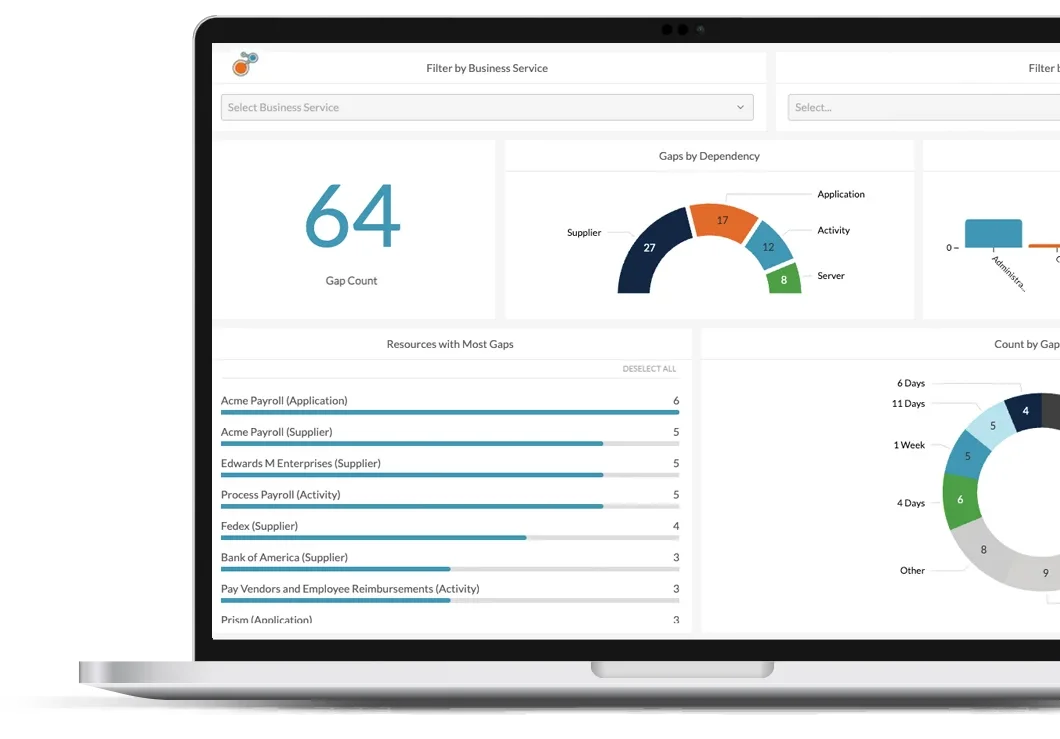
Business Continuity Management dashboard on laptop screen

Business Continuity Management Software

Product Highlights

  • Strategic Continuity
    Planning
    Establish, document, and routinely update response and recovery plans and strategies to limit downtime and speed your return to normal.
  • Impact Analysis
    and Risk Assessment
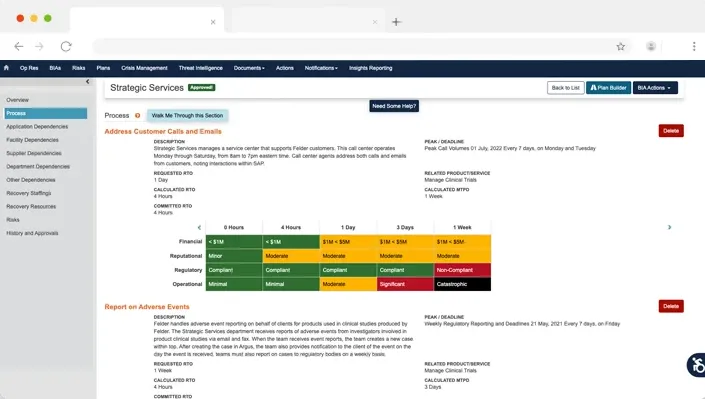
    Automatically evaluate business processes and activities, establish requirements, map dependencies, and highlight vulnerabilities to disruption to simplify analysis.
  • Gap Analysis
    and Actions
    Identify where business continuity requirements and capabilities fall short and assign corrective actions, risk treatments, and opportunities for improvement.
  • Business
    Model Definition
    Create a consolidated data model, from supplier to customer, that enables preparedness and time response for a wide range of disruptions.
  • Resilience
    Testing Exercises
    Stress-test your plans against disruption scenarios to flag opportunities for improvement and create confidence.


Trey Braden at Randstad

One of the big features for Riskonnect is that it’s a cloud solution. I can get to it from any device with a signal. This empowers our leaders, particularly those recovery team members that might not be looking at the plan every day. Being able to access tasks on the mobile app really helps in eliminating single points of failure

Brad Henske, of Business Continuity and Resilience, Carilion Clinic
Tap into a Wealth of Experience

With Business Continuity

Management Software

Spinning your wheels without getting the traction you need? Riskonnect’s Business Continuity Management software provides out-of-the-box functionality, workflows, and templates based on best-in-class practices that provide faster implementation, minimal configuration, and less time to attain program objectives.

  • Speed the process of building and refining your program with the built-in global library of plan, incident, business impact analysis, and document templates.
  • Reduce manual effort by triggering actions and notifications using the customizable workflow builder.
  • Seamlessly share information and reduce human error by connecting to gold-source data repositories.
  • Leverage out-of-the-box alignment with ISO 22301, including corrective actions and management reviews.
Connect with Executives
Using Metrics that Matter

Are you struggling to capture the attention of leaders? Riskonnect’s Business Continuity Management software offers an intuitive interface and robust reporting to provide clarity, insight, and access for leaders.

  • Develop meaningful scorecards, dashboards, and reports that summarize key performance and risk indicators for internal and external stakeholders.
  • Demonstrate the full scope of risk to your leaders using “what if” modeling to visualize relationships and business service-level analysis.
  • Easily access program information and incident management on-the-go via the mobile application.
               

Get Everyone Involved

Are your plans less effective because of low interest? Riskonnect’s Business Continuity Management software is intuitive and accessible to even the most casual user with no need for extensive training or a dedicated administrator.

  • Allow department owners to update plans easily and consistently.
  • Offer built-in guidance to help infrequent users navigate the software like a pro.
  • Secure access based on your security standards, including single sign-on and two-factor authentication.

Get Started with These Helpful Resources

EBOOK
Your Step-by-Step Guide to
Effective Business Resilience
Dealing with cascading challenges takes a nimble approach. Get started with this guide, which has a five-step framework for achieving resilience.
EBOOK

Your Guide to Cyber Resilience

Cybercrime is one of the biggest threats to any business in any industry. This ebook explains what a comprehensive cyber resilience plan is, what’s at stake, and how to strengthen your approach.
RFP TEMPLATE
Starting an RFP process for
business continuity software?
Download Riskonnect’s list of the most critical business continuity software-related questions and customize it to suit your needs.

Customers with Enhanced

Business Continuity Programs Also Use

IT Risk Management
Identify your top IT, cyber, operational resilience, and other technology risks to minimize the financial impact.
Risk Management
Information System
Seamlessly consolidate data from multiple sources, automate routine processes, and use sophisticated analytics to turn complicated information into actionable intelligence.
Enterprise Risk
Management
Combine insurable and noninsurable risks so you can anticipate, assess, mitigate, and monitor every threat from every corner of the organization.

Start anywhere. Expand everywhere.

Industry Recognition for Riskonnect

Redhand Advisors Forrester Wheelhouse Advisor

Start partnering with Riskonnect today.
Find out how Riskonnect can transform the way you view risk.

Your Business Continuity Management Software Questions Answered

Business continuity management software is a purpose-built platform for developing, maintaining, testing, and improving an organization’s business continuity program. It centralizes the planning process — business impact analyses, continuity and recovery plans, gap assessments, resilience testing exercises, and compliance documentation — in one system that keeps everything current and accessible. Unlike general document management tools or spreadsheets, BCM software automates the administrative work of running a program: triggering plan reviews, routing approvals, tracking action items, and generating the reports that demonstrate program health to leadership and regulators. The goal is a program that runs continuously and consistently, not one that gets dusted off when an incident occurs.

A business impact analysis (BIA) is the foundational assessment of a BCM program: the process of identifying which business processes and services are critical, what resources they depend on, and what the consequences of disruption would be over time — financial, operational, reputational, and regulatory. The BIA establishes the recovery priorities that drive everything else in the program: which processes need to recover first, how quickly they need to recover (the Recovery Time Objective, or RTO), and how much data loss is acceptable (the Recovery Point Objective, or RPO). BCM software supports the BIA process by providing structured templates, automating data collection from process owners across the organization, mapping dependencies between processes and resources, and consolidating findings into reports that inform plan development and resource allocation decisions.

These are two of the most important metrics in any business continuity management program. The Recovery Time Objective (RTO) is the maximum amount of time a business process or system can be unavailable before the disruption causes unacceptable consequences — in other words, how quickly it needs to be restored. The Recovery Point Objective (RPO) is the maximum period of data loss that is acceptable — essentially, how far back a data restore can reach without causing unacceptable damage. RTOs and RPOs are established through the BIA process and drive decisions about recovery strategies, IT backup architecture, and resource prioritization. BCM software maintains these parameters in the plan record, uses them to drive recovery prioritization, and reports on whether actual recovery capabilities align with the established objectives.

A well-structured business continuity plan typically includes: the scope and objectives of the plan, and which business processes or services it covers; the results of the BIA and the RTOs and RPOs for each covered process; defined disruption scenarios and the specific response strategies for each; response team roles, responsibilities, and contact information; activation procedures — the triggers and steps for moving from normal operations to plan activation; recovery procedures for each critical process, including workarounds and alternate resources; communication protocols for internal teams, customers, regulators, and other stakeholders; and a testing and review schedule to keep the plan current and validated. BCM software provides templates and workflows that ensure all of these elements are documented consistently, and automates the review and approval process so plans don’t go stale.

Industry standards — including ISO 22301 — require that BCM programs be tested regularly, but the right frequency depends on the organization’s risk profile, the rate of change in its operating environment, and regulatory requirements. At minimum, most programs conduct an annual review and test cycle for each plan. High-risk or highly regulated organizations typically test more frequently. Testing can range from simple document reviews and tabletop exercises — where the response team walks through a scenario without activating any actual response — to full simulation exercises that test response procedures under realistic conditions. Riskonnect’s business continuity software includes resilience testing exercise tools that stress-test plans against disruption scenarios and automatically flag gaps identified during testing as corrective actions.

ISO 22301 is the international standard for business continuity management systems. It specifies the requirements for implementing, operating, monitoring, reviewing, maintaining, and improving a documented BCM system — essentially, what a mature BCM program needs to have in place to be considered well-managed. Key requirements include top management commitment, a defined scope and policy, BIA and risk assessment processes, documented continuity strategies and plans, a competency and awareness program, regular exercises and testing, and a structured management review and continual improvement cycle. BCM software supports ISO 22301 compliance by providing out-of-the-box alignment with the standard’s structure, generating the documentation required at each stage, and maintaining the corrective action and management review records the standard requires. Riskonnect’s platform includes this alignment out of the box.

Business continuity management is the broader discipline — it addresses how an organization maintains critical business functions and services across a wide range of disruption scenarios, not all of which are IT-related. It encompasses people, processes, facilities, suppliers, and communications, not just technology systems. Disaster recovery (DR) is a subset of BCM that focuses specifically on restoring IT systems and data after a failure or catastrophic event. A DR plan specifies how systems will be backed up, where they’ll be restored, and in what order. Good BCM programs include a disaster recovery component, but DR alone doesn’t constitute a BCM program — it doesn’t address how the business operates while systems are being recovered, or how to maintain customer-facing services through a disruption that doesn’t involve a system failure at all.

The scenarios that a BCM program prepares for are, by definition, the high-impact risk events that appear in the enterprise risk register. When BCM software is connected to an enterprise risk management platform, risk teams can see which enterprise risks have documented continuity plans, which plans have been tested and validated, and where recovery capabilities fall short of what the risk assessment implies is needed. This connection also flows in the other direction: new risks identified through the ERM process can trigger BCM plan updates, and incidents that occur can feed back into risk assessments. Riskonnect is built for this integration — BCM and ERM share the same platform, so continuity preparedness is visible in the context of the broader organizational risk picture.

The most important considerations when evaluating BCM software are: quality of out-of-the-box content (plan templates, BIA frameworks, workflow configurations) that reduce time to program maturity; ease of use for non-specialist users who own individual plans but aren’t BCM professionals; mobile accessibility for response team members during an actual incident; depth of integration with crisis management and emergency notification capabilities; ISO 22301 alignment and compliance documentation support; and the strength of the link to enterprise risk, IT risk, and operational resilience programs. The BCM RFP template Riskonnect provides covers the evaluation criteria in detail and is a practical tool for ensuring you’re comparing solutions on the dimensions that actually matter when a disruption occurs.

AI is beginning to change what’s possible in BCM in several meaningful ways. Plan generation — historically one of the most time-consuming parts of building a BCM program — can be accelerated significantly by AI that drafts initial plan content based on the organization’s data model and industry context. Scenario-based stress testing can be enriched by AI that runs simulations against threat intelligence data to identify weaknesses in plans before they’re tested by a real event. And the Business Resilience Agent capability in Riskonnect analyzes stress test results and recommends corrective actions, turning testing from a compliance exercise into a genuine improvement process. The practical effect is that BCM teams can maintain more current, more thoroughly tested programs without proportionally increasing administrative effort.