
Insurable Risk Solutions

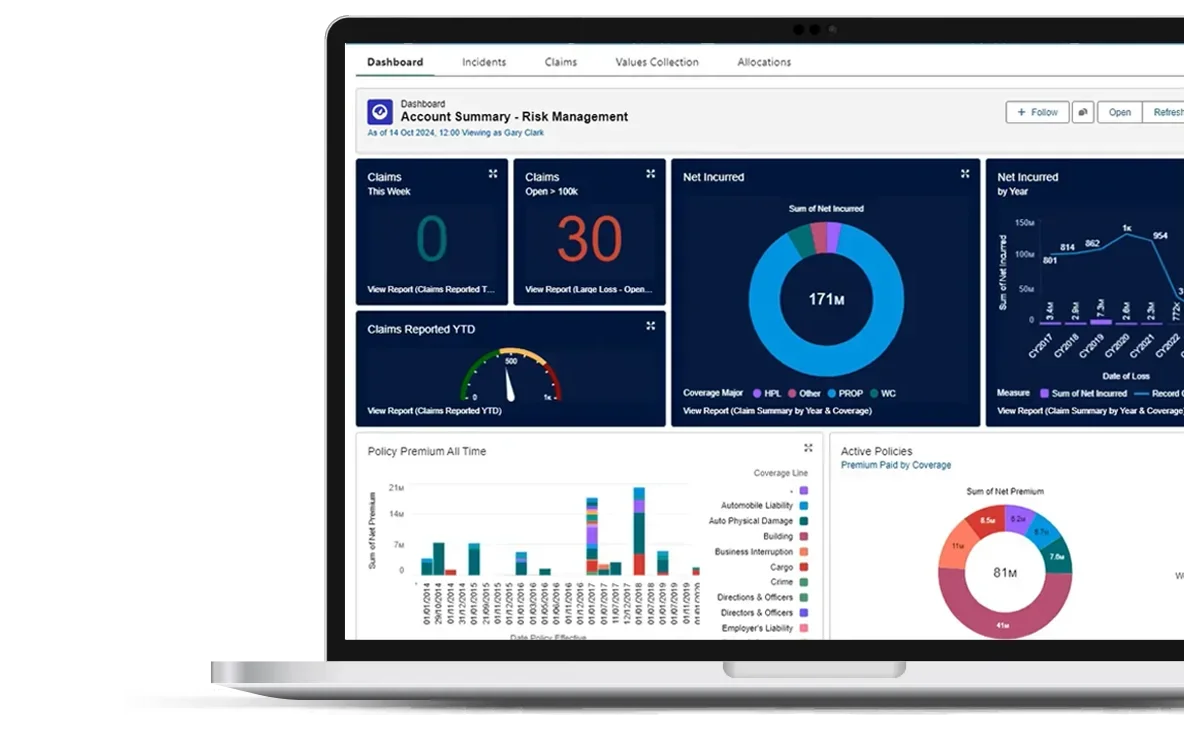
Riskonnect’s risk and claims management solutions consolidate your insured risk data to give you a clear view of your risks, the relationships, and the impact on the organization.

Spend your time where it matters most. Streamline processes, automate workflows, and eliminate duplication of effort to free up valuable resources and get more done.

Uncover insights you can trust. Consolidate data from all stakeholders and systems – including carriers, TPAs, vendors, brokers, and employees – into one, easily accessible view.

Optimize your insurance spend. Turn complicated data into actionable insights to improve pricing and coverage decisions.
Risk and Claims Management Software

Product Highlights

Seamlessly consolidate data from multiple sources, automate routine processes, and use sophisticated analytics to turn complicated information into actionable intelligence.
LEARN MORE

Integrate people, systems, and claims data, and automate routine processes so you can focus on resolving even the most complex claims, quickly, easily, and fairly.
LEARN MORE
Manage the insurance policy lifecycle, from inception through renewals.
LEARN MORE
Streamline the insurance payment process to efficiently service your policyholders and agents.
LEARN MORE
Track all safety processes, training status, compliance requirements, hazard data, and incidents to systematically improve safety, reduce future incidents, and cultivate greater safety awareness within your organization.
LEARN MORE

AI in Insurable Risk

Gain early visibility into emerging-loss trends, litigation risk, and claim severity – while reducing
manual effort across intake, documentation, and analysis.


Automated Claim Coding and Document Classification

Classify claim details – like part, cause, and nature – automatically and generate clear document summaries.

Notes and Claim File Summarization

Extract and summarize adjuster notes, medical records, and claim files.

OCR for Certificates of Insurance

Read and auto-populate ACO.

Dynamic Reserve Prediction

Automatically score and rescore reserve levels as new claim data becomes available.

Intelligent Intake Agent

Automatically code new claims at intake and flag missing or inconsistent data.

Discount Tire


I wasn’t looking for a platform to do just claims management, but I really wasn’t sure what I was looking for until we got deeper into Riskonnect and became aware of what we could do. Riskonnect has done a really nice job of helping us aggregate [claims] data and turn it into actionable insights that we can use. And our safety program has excelled at leveraging that information.

Chris Henrichsen, Risk and Litigation Officer, Discount Tire

 IHG® Hotels & Resorts


Riskonnect is helping us in terms of achieving financial accuracy for payments for insurers, which is great. We have full visibility of what’s going on in terms of claims management from start to end.

Marcela Siera, Insurance Systems Manager, IHG® Hotels & Resorts

Randstad 


Riskonnect has allowed us to embark on actions we’ve never had clarity on before. If no action is coming out of the data, what’s the point.

Trey Braden, Director, Risk Management, Randstad

Ranstad
Los_Alamos_National_Laboratory_logo
Transport-for-London-Logo-color

Riskonnect Stands Out In

Redhand RMIS Report

Riskonnect is one of the most comprehensive RMIS solutions on the market, according to the respected RMIS Report by Redhand Advisors. The report is designed to provide buyers with unbiased analysis to better understand the RMIS market and available technology.

Reduce
TCOR

Feeling the pressure to reduce total cost of risk – in less time with fewer resources? Riskonnect’s risk and claims management software seamlessly integrates people, systems, and data to help you make more informed decisions about risk to keep costs in check.

  • Consolidate real-time risk data from multiple internal and external sources to identify trends, emerging risks, and opportunities.
  • Understand the relationships between critical risks and the impact on the organization.
  • Seamlessly integrate data from carriers, TPAs, third-party vendors, and internal departments into one source of truth.
  • Gain strategic insights to optimize your insurance program.
  • Identify cost-savings opportunities that previously may have gone unnoticed.

Say Goodbye
to Frustration

How much time is wasted tracking down information with endless back-and-forth emails or adding it to yet another spreadsheet? Riskonnect’s risk and claims management software streamlines and automates routine processes so you can spend your time delivering human-worthy insights from data you trust.

  • Save time and money by streamlining and automating processes.
  • Capture data consistently and thoroughly with standard templates, intuitive forms, and auto-filled fields.
  • Minimize human error by guiding users through the data-collection process.
  • Eliminate duplicate data entry by automatically uploading information.
  • Send alerts, reminders, and progress reports automatically.
  • Communicate seamlessly using SMS text, WhatsApp, and other channels.
Pave Your Way to Success

with a Trusted Platform

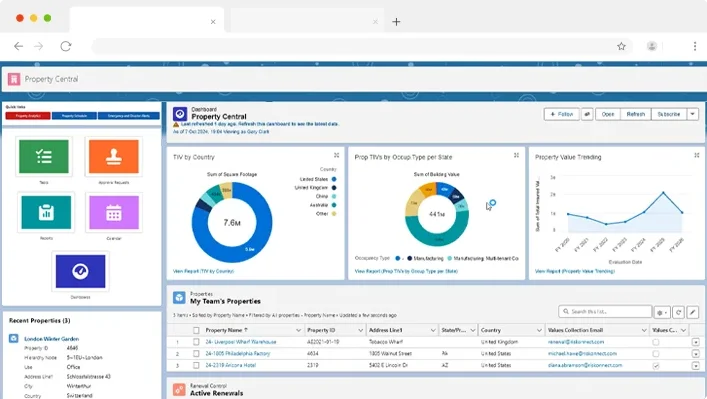
Riskonnect is a cloud-based platform that puts everything you need to manage risk right where you need it, when you need it.  

Get Started with These Helpful Resources

EBOOK
The Top 5 RMIS Tools
This ebook dives into the top RMIS applications and explains how they can help you become more efficient, more effective – and ultimately, lower your total cost of risk.
ASSESSMENT
Do you need a RMIS?
Whether or not you need a RMIS depends on the complexity of your risks and how sophisticated your needs are. Here are 11 questions to help you decide.
RFP TEMPLATE
Starting an RFP process for risk
and claims management software?
Download Riskonnect’s list of the most critical questions to ask potential vendors and customize it to suit your needs.

Customers with Enhanced

Insurable Risk Programs Also Use

Governance, Risk &
Compliance (GRC)
Get the visibility to identify and address uncertainty to achieve your business objectives.
Business Continuity
& Resilience
Prepare for threats and minimize disruption to operations.

Start anywhere. Expand everywhere.

Industry Recognition for Riskonnect

Redhand Advisors Forrester Wheelhouse Advisor

Start partnering with Riskonnect today.
Find out how Riskonnect can transform the way you view risk.

Your Insurable Risk Software Questions Answered

Insurable risk refers to the specific category of organizational risk that can be transferred to an insurer through an insurance policy — property damage, general liability, workers’ compensation, auto liability, professional liability, and similar exposures. These are risks with a defined financial impact that can be priced and underwritten by insurers. Enterprise risk is the broader discipline that encompasses all material risks to an organization’s objectives, including strategic, operational, financial, reputational, and compliance risks — most of which are not insured. In practice, insurable and non-insurable risks are deeply connected: workers’ compensation claims arise from operational safety failures; property losses connect to business continuity risk; liability exposures reflect governance and compliance posture. Organizations with mature risk programs manage both together rather than treating insured risk as a separate function from the broader enterprise risk picture. For a deeper look at why this integration matters, see 4 Reasons Why Insurable Risk Should Be Part of Your IRM Program.

Insurable risk software — sometimes called risk and claims management software — is a platform for managing the full lifecycle of an organization’s insured risk program: capturing and tracking loss events and claims, managing insurance policies and certificates, allocating premiums and costs to the business units that generate them, collecting exposure data for renewals, and analyzing loss experience to identify trends and cost reduction opportunities. At its core, it replaces the manual coordination and spreadsheet-based data management that most risk teams rely on, replacing it with consolidated, automated, and analytically rich systems that give risk managers — and their leadership — a clearer picture of what’s happening across the insurance program and what to do about it.

Total cost of risk (TCOR) is the comprehensive measure of everything an organization spends on risk — insurance premiums, retained losses, claims administration costs, risk management operating expenses, and the indirect costs of uninsured losses. It’s the metric that tells risk managers and CFOs what risk is actually costing the business in full, not just the line items that show up on the insurance budget. Insurable risk software reduces TCOR by surfacing the data needed to make smarter decisions at every stage of the risk cycle: identifying the loss drivers that are inflating premiums, enabling faster and more accurate claims resolution to reduce duration and expense, automating cost allocation to create financial accountability at the business unit level, and providing the analytical foundation for better-informed negotiations at renewal. Without consolidated loss and exposure data, most organizations are managing risk costs reactively rather than strategically.

A comprehensive insurable risk platform covers the full lifecycle from exposure management through loss and recovery. The major components are: a Risk Management Information System (RMIS) for consolidating loss data, exposure information, and insurance program details; Claims Management for tracking claims from first notice of loss through adjudication, payment, and subrogation; Policy Administration for managing the insurance policy lifecycle; certificate of insurance management for tracking third-party coverage compliance; cost allocation for distributing premiums and losses to the right cost centers; incident management for capturing safety events before they become claims; and analytics and reporting for translating raw data into actionable insights. The value of a platform that covers all of these is the ability to trace a loss event from incident through claim through policy impact through premium effect — rather than managing each step in a separate system.

A certificate of insurance (COI) is a document that verifies a vendor, contractor, or tenant carries the insurance coverage your organization requires before allowing them to work on your premises, access your facilities, or provide services to your organization. Managing COIs manually across a large vendor base is labor-intensive and error-prone: expiration dates get missed, required coverage thresholds aren’t verified, and non-compliant vendors slip through. Insurable risk software automates COI management by maintaining a central repository of all incoming certificates, reading and extracting coverage details automatically using OCR technology, flagging certificates that don’t meet coverage requirements, alerting on expiring certificates before coverage lapses, and generating compliance reports that show at a glance which vendors are in or out of compliance. Riskonnect’s AI capabilities extend this further — OCR for certificates of insurance automatically reads and populates certificate data, reducing manual entry and improving accuracy at scale.

AI is beginning to transform insurable risk management in practical, measurable ways. At the claims intake stage, AI can automatically classify claim details — cause, nature, body part, and other coding fields — and flag missing or inconsistent data at the point of entry, improving data quality and reducing adjuster administrative burden. Document summarization capabilities extract and condense adjuster notes, medical records, and lengthy claim files into clear summaries that give adjusters and risk managers the relevant information faster. Dynamic reserve prediction automatically scores and rescores reserve levels as new claim information becomes available, improving reserve accuracy throughout the claim lifecycle. And in the aggregate, AI-powered analytics surface emerging loss trends and litigation signals that would take a risk analyst hours to identify manually — giving risk teams more time for the analysis and decision-making that actually reduces losses. These AI capabilities in Riskonnect’s insurable risk platform represent a meaningful shift from reactive reporting to proactive risk intelligence.

One of the most persistent operational challenges in insurable risk management is consolidating loss data from multiple insurers, third-party administrators, and other external sources — each of which may use different data formats, coding conventions, and transmission methods. Insurable risk software addresses this through data transformation capabilities that normalize data from disparate sources into a consistent format that supports analysis and reporting across the entire program. Riskonnect’s platform can handle data from over 900 external systems, including major carriers and TPAs, ingesting information in multiple formats and currencies and integrating it into a single source of truth. This consolidated view is what makes program-wide loss analysis, cost allocation, and renewal preparation possible — without it, risk teams are stitching together spreadsheets from multiple sources and spending more time on data management than on insight.

The traditional separation between insurable risk management and ERM is one of the most consequential gaps in how organizations manage risk. Insured losses are a subset of enterprise risk: the loss drivers that inflate workers’ compensation premiums are the same operational safety risks that appear in the enterprise risk register; the liability exposures managed by the claims team are the same reputational and operational risks that the board cares about. When insurable risk software and enterprise risk management share the same platform, the risk manager’s view of claims and insurance data becomes visible to the ERM team as evidence of operational risk outcomes — and ERM risk assessments inform the insurable risk program’s prioritization of loss control investments. Riskonnect is built specifically for this integration, allowing organizations to connect insurable and non-insurable risk data in a single platform rather than managing them as disconnected programs.

Any organization that manages a meaningful insured risk program benefits from purpose-built insurable risk software. The need is most acute for self-insured employers — large corporations, healthcare systems, educational institutions, municipalities, and other organizations that retain a significant portion of their insured risk rather than fully transferring it to carriers. For these organizations, claims data and loss experience are directly tied to operating costs, making accurate data and fast analysis financially significant. Organizations with large contractor or vendor populations benefit significantly from automated COI management. Multi-location organizations benefit from cost allocation capabilities that create accountability for loss generation at the business unit or location level. And any organization managing workers’ compensation programs across multiple states benefits from the regulatory compliance and electronic filing capabilities that insurable risk platforms provide.

Evaluating insurable risk software should start with an honest assessment of where your current program creates the most friction: Is it data consolidation from multiple carriers and TPAs? Claims management efficiency? Inability to produce the reports leadership needs? COI compliance gaps? Or the renewal data collection process? Different platforms have different strengths, and knowing your primary pain points prevents buying capabilities you won’t use. Key criteria for leading insurable risk platforms include: breadth of carrier and TPA data integration; depth of claims management workflow support across the lines of business you manage; quality of cost allocation and analytics capabilities; COI management with automated extraction and compliance tracking; regulatory compliance support including workers’ compensation electronic filing; and integration with your ERM, health and safety, and GRC programs. Riskonnect’s RMIS RFP template provides a comprehensive set of evaluation questions for comparing top insurable risk software vendors — and the RMIS Definitive Guide covers the full market landscape.