
Operational Resilience Software

Riskonnect’s Operational Resilience software strengthens your ability to prevent, withstand, respond to, and learn from operational disruptions.

Simplify compliance. Meet regulatory requirements – including those from the Bank of England, DORA, and the CER Directive – and document compliance artifacts automatically.

Know where you are vulnerable. Get a comprehensive view to understand your weaknesses, so your crisis management and business continuity teams can better plan.

Prioritize your actions. Identify your most important business services, impact tolerance metrics, and severe, yet plausible, disruption scenarios for clear and confident preparation.
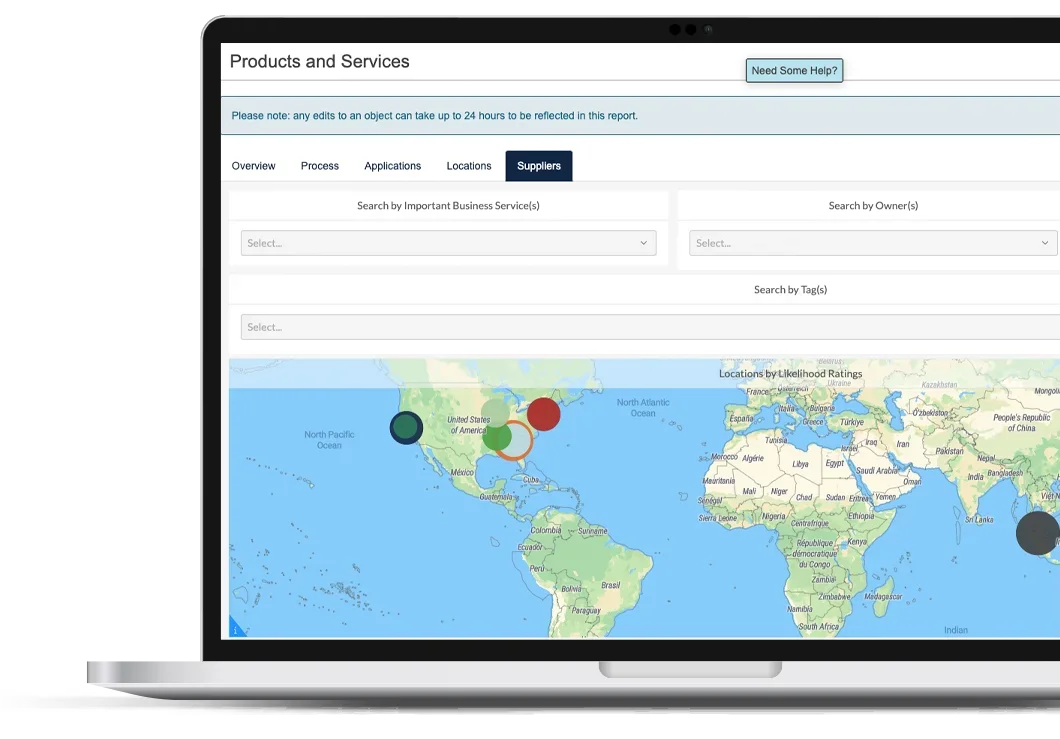
Operational Resilience Software dashboard on laptop screen

Operational Resilience Software

Product Highlights

  • Plausible Scenarios
    Identify possible sources of disruption and connect them to specific business services to model impact and vulnerability.
  • Impact Tolerance
    Quickly identify and address potential gaps in your ability to tolerate disruptions, and view products and services by committed, proven, and lowest calculated impact tolerance.
  • Self-Assessment
    Reporting
    Provide stakeholders with clear visibility of your program’s structure and its effectiveness at creating resiliency for your products and services.
  • Process Mapping
    Create an end-to-end digital model of your business services and underlying processes to understand obligations, vulnerabilities, and disruption impacts.
  • Criticality Assessment
    Craft configurable, explainable criticality scores to intelligently define and prioritize business processes, technology, third parties, and their dependencies.


The biggest thing for us is [Riskonnect’s] user-friendly interface. It’s just so easy to use. You can have the best tool in the world, but if no one is able to use it, it’s pretty irrelevant.

Scott Hughes, Senior Manager, Operational Resilience, Nationwide Building Society

Visualize the Impact

of Disruption on Your Customers

What would happen to your customers – and the market – if your services were disrupted? Riskonnect’s Operational Resilience software defines your customer segments, analyzes criticality, and digitally illustrates the impact of a disruption, including obligations and expectations that could otherwise be missed.

  • Map your customer segments to specific obligations, delivery channels, products, and services.
  • Track important details about each product and service in one place to understand which customers are served by each and how you facilitate delivery.
  • Understand the downtime impact on customers, the market, and internal operations with visual impact and criticality profiles that scale from minor to catastrophic over time.

Expose Hidden
Vulnerabilities

Do you have the visibility to easily identify gaps in your program where undetected risks could be hiding? Riskonnect’s Operational Resilience software gives you a holistic view so you can see your weaknesses and shore them up before they cause trouble.

  • Identify likely sources of disruption with potential catastrophic consequences and connect them to specific business services to model impact and vulnerability.
  • Analyze critical dependencies across processes, technology, and third parties to reveal hidden risks and single points of failure.
  • Stress-test a plan or exercise against a plausible scenario to expose any gaps or misalignments in your response and recovery methods.

Generate Reports

that Resonate with Executives

Can you prove the value of your business continuity and resilience program? Riskonnect’s Operational Resilience software offers robust reporting to demonstrate you’ve done all you can to protect the organization.

  • Use “what if” modeling to visualize relationships and business service-level analysis.
  • Customize dashboards to focus on products and services, displaying all the linked activities, applications, locations, and suppliers.
  • Measure resilience based on customer pain and product and service availability to give powerful context for senior leaders.
Get Started with These Helpful Resources


EBOOK
Getting Started with
Operational Resilience
This guide will set you up with a solid foundation for operational resilience, get traction with executives, and boost confidence that you can bend without breaking.
WHITE PAPER
Need help navigating the operational
resilience regulations worldwide?
Download Riskonnect’s Operational Resilience: Navigating the Global Regulatory Landscape to understand jurisdictional regulations, common best practices, and how to apply these concepts in a practical way.
RFP TEMPLATE
Starting an RFP process for
business continuity software?
Download Riskonnect’s list of the most critical business continuity software-related questions and customize it to suit your needs.

Customers with Enhanced

Operational Resilience Programs Also Use

Business Continuity
Management
Conduct business impact analyses, engage stakeholders, comply with regulations, and continuously improve your readiness.
Compliance
Aggregate all corporate and legal policies, procedures, and requirements from across the organization into one centralized location.
Enterprise Risk
Management
Combine insurable and noninsurable risks so you can anticipate, assess, mitigate, and monitor every threat from every corner of the organization.

Start anywhere. Expand everywhere.

Industry Recognition for Riskonnect

Redhand Advisors Forrester Wheelhouse Advisor

Start partnering with Riskonnect today.
Find out how Riskonnect can transform the way you view risk.

Your Operational Resilience Questions Answered

Operational resilience is an organization’s ability to prevent, withstand, adapt to, and recover from disruptions — not just to restore normal operations after an incident, but to continue delivering critical services to customers and the market even while a disruption is underway. Where business continuity planning focuses on how to recover from specific disruption scenarios, operational resilience asks a more fundamental question: which services are so important that they must never be interrupted beyond a defined tolerance level, regardless of the cause? This shift from recovery-centric to service-continuity-centric thinking is at the heart of the regulatory frameworks now being adopted across financial services and other regulated sectors globally. For a fuller explanation of the distinction and why it matters, see What is Operational Resilience and Its Importance in Business?

Operational resilience software is a platform for building, managing, and demonstrating an organization’s capacity to maintain critical business services in the face of operational disruptions. It provides the structured tools needed to identify and map important business services, model the dependencies between services and the processes, technology, people, and third parties that support them, define impact tolerances for each service, identify vulnerabilities and single points of failure, run scenario-based stress tests, and generate the regulatory reporting and self-assessment documentation that regulators require. Unlike general business continuity tools, operational resilience software is specifically designed around the service-level outcomes that matter to customers and regulators — not just the recovery of internal processes.

Impact tolerance is the maximum level of disruption an organization — or its regulator — is willing to accept for a specific business service before that disruption causes unacceptable harm to customers, the market, or the organization’s viability. It’s a concept central to the Bank of England’s operational resilience rules, DORA, and other regulatory frameworks: organizations must not only define impact tolerances but demonstrate they can remain within them under severe and plausible disruption scenarios. Software supports this by providing structured workflows for setting impact tolerance metrics, modeling how disruptions of varying severity and duration would affect service delivery over time, tracking the gap between current capabilities and defined tolerances, and producing the documentation regulators expect. Without software, managing impact tolerances across a portfolio of important business services becomes an unmanageable administrative burden.

Operational resilience has moved from a best practice to a regulatory requirement across multiple jurisdictions. In the UK, the Bank of England (PRA/FCA) requires financial services firms to identify important business services, set impact tolerances, and demonstrate they can remain within those tolerances. DORA (Digital Operational Resilience Act) is the EU’s framework governing digital operational resilience for financial entities — including banks, insurers, investment firms, and critical ICT service providers — with mandatory requirements for ICT risk management, incident reporting, resilience testing, and third-party oversight. The CER Directive (Critical Entities Resilience) extends resilience obligations to critical infrastructure operators across sectors including energy, transport, healthcare, and digital infrastructure in EU member states. APRA in Australia and FFIEC in the US have issued guidance with parallel themes. The common thread across all of these frameworks is the requirement to demonstrate, not just assert, that important services can withstand disruption. For a detailed overview of how these frameworks compare, see Riskonnect’s Operational Resilience: Navigating the Global Regulatory Landscape.

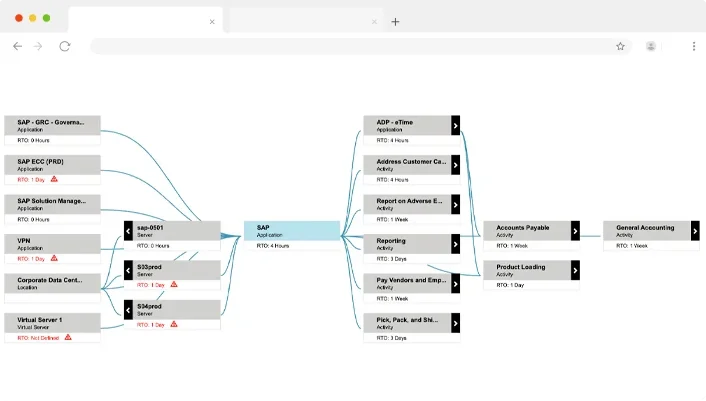
Process mapping in operational resilience means creating a comprehensive digital model of how each important business service is actually delivered — the processes, technology systems, locations, people, and third-party providers that must function correctly for the service to be available to customers. This end-to-end service map is the foundation of everything else in an operational resilience program: you can’t define impact tolerances you don’t know you have, identify single points of failure you can’t see, or test scenarios that don’t accurately reflect how your services operate. The maps also reveal dependencies that traditional risk registers miss — a critical technology system shared across multiple services, a third-party provider that is a single point of failure for several processes, or a geographic concentration that creates resilience risk. Riskonnect’s process mapping capability builds this model digitally, allowing organizations to navigate from any service through to the full chain of dependencies. For practical guidance on building out an operational resilience program step by step, see How to Build Operational Resilience.

A plausible scenario is a defined disruption event — severe enough to threaten an important business service but realistic enough to actually occur — used to stress-test an organization’s resilience capabilities. Regulators require organizations to demonstrate that they can remain within their impact tolerances under severe but plausible scenarios, not just under minor or unlikely disruptions. Examples include a major technology failure, a cyber incident, a third-party provider outage, a natural disaster affecting a key facility, or a pandemic-level workforce disruption. Operational resilience software supports scenario testing by connecting defined scenarios to the service maps and dependency models, simulating the cascading impact of different disruptions on service delivery, identifying where current capabilities fall short of impact tolerances, and generating action plans for the gaps discovered. This stress-testing capability is what distinguishes a mature operational resilience program from a theoretical framework.

A criticality assessment is the process of evaluating and scoring the relative importance of business services, processes, technology systems, third parties, and other components of the organization’s operating model — determining which are critical to maintaining important business services and which represent the greatest resilience risk if they fail. In operational resilience software, criticality assessments are configurable: organizations can define the scoring methodology that reflects their specific service obligations, regulatory requirements, and risk appetite. The output is an intelligible, defensible priority ordering that guides investment decisions, remediation actions, and the sequencing of resilience testing — so resources are concentrated where the consequences of failure are most severe. Riskonnect’s platform supports configurable, explainable criticality scores that can be customized to the organization’s requirements while maintaining the transparency regulators expect.

A core regulatory expectation under UK PRA/FCA rules, DORA, and similar frameworks is that organizations produce structured self-assessments documenting the scope of their important business services, the impact tolerances set for each, the vulnerabilities identified through mapping and testing, and the actions taken or planned to address gaps. This documentation must be produced on a regular basis, maintained as a current record, and be available for regulatory inspection. Operational resilience software automates much of this documentation burden: the self-assessment report is generated directly from the program data — service maps, impact tolerance definitions, scenario test results, and action tracking — rather than assembled manually from disconnected sources. Riskonnect’s Self-Assessment Reporting capability provides stakeholders with clear visibility of program structure and effectiveness, producing the kind of evidence-based documentation that demonstrates genuine operational resilience rather than compliance on paper.

Operational resilience, business continuity management, and third-party risk management address overlapping aspects of the same underlying challenge — ensuring organizations can continue to deliver important services when things go wrong. The most effective programs connect all three. Business continuity management provides the plan-level recovery capability that operational resilience programs draw on when a scenario is activated. Third-party risk management identifies and monitors the vendor and supplier dependencies that show up in service maps as potential single points of failure. When these functions share a platform, the operational resilience team can see whether BCM plans exist and are tested for every critical dependency, and whether TPRM assessments have been completed for every critical third party that appears in the service maps. Riskonnect is built specifically for this integration — operational resilience, BCM, and TPRM all share the same data environment.

The evaluation should start with your regulatory context: if you’re a UK financial services firm subject to PRA/FCA requirements, or an EU financial entity subject to DORA, the software must support the specific documentation and self-assessment structures those frameworks require — not just general resilience management. Key criteria for leading operational resilience platforms include: depth of process mapping and dependency modeling capabilities; structured impact tolerance management with scenario simulation; regulatory self-assessment reporting aligned to the frameworks you’re subject to; integration with BCM, TPRM, and compliance programs in the same platform; ease of use for the program owners and department-level contributors who build and maintain service maps; and the quality of implementation support. Riskonnect’s BCM and resilience RFP template covers operational resilience requirements alongside the broader resilience program, and the Getting Started with Operational Resilience ebook provides a practical foundation for organizations beginning or maturing this program.