
Project Risk Management Software

Riskonnect’s project risk management software helps you effectively manage project risks to keep projects on track for successful completion.

View risk from the project level up through the enterprise. See risk from every perspective – including the relationships between risks – to make more effective decisions.

Keep your projects on budget and on schedule. Understand the upstream and downstream impacts of project risks to prioritize risk-mitigation activities.

Intercept small problems before they become expensive disruptions. Forecast impacts and manage resources across projects and programs to address threats as they emerge.
Project Risk Management

Product Highlights

  • Bowtie Cause-and-Effect
    Analysis
    Expand your risk view to prepare for deeper analysis of key events, which helps identify critical controls.
  • Dashboards
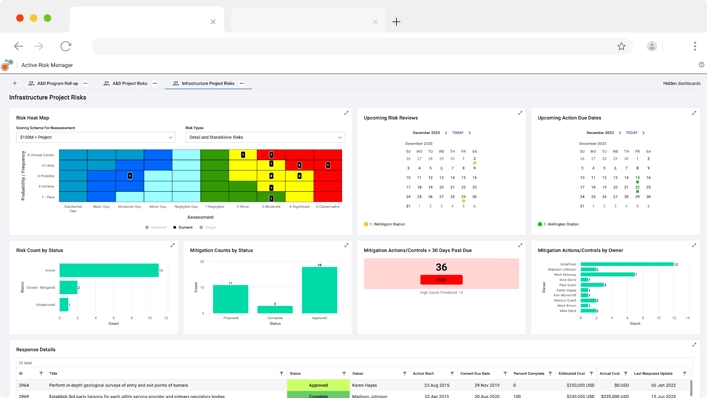
    Communicate the status of risks and other key indicators – including customizable KRIs and KPIs – quickly and effectively.
  • Heat Maps
    Present leaders with a meaningful visualization of your assessed risks to intelligently prioritize actions.
  • Risk
    Registers
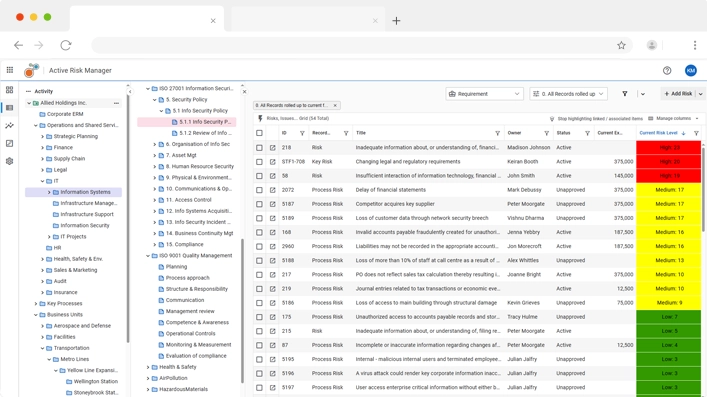
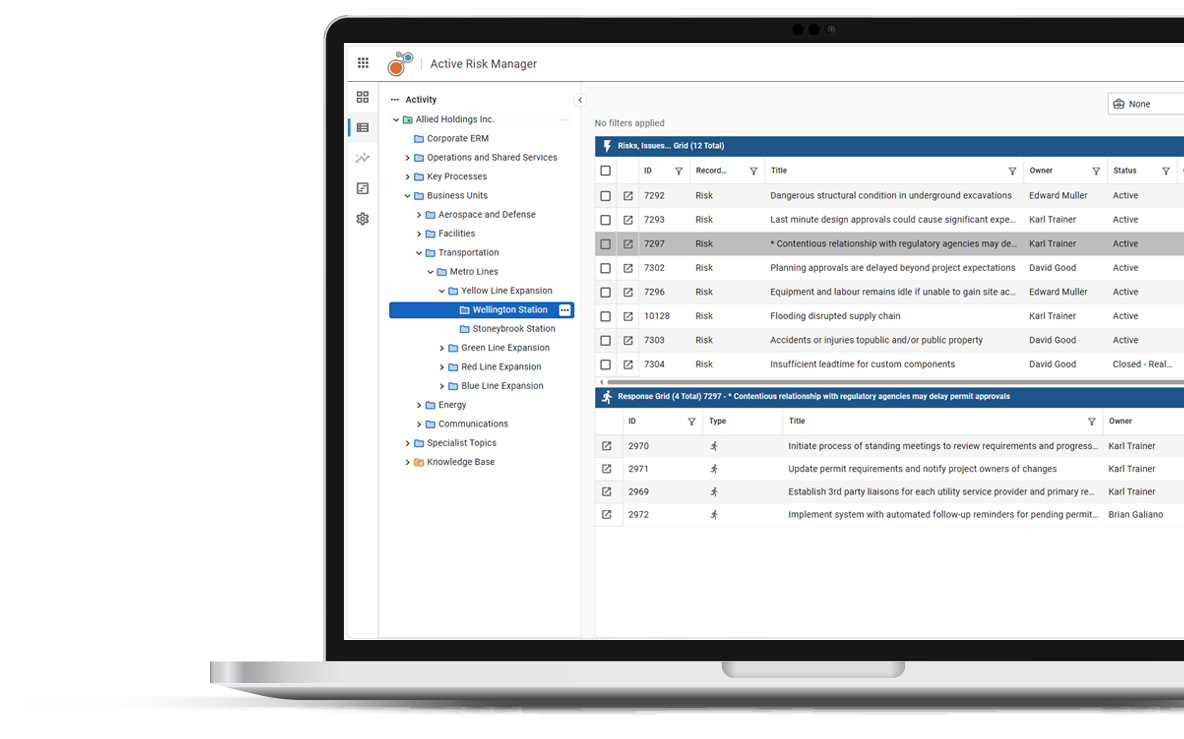
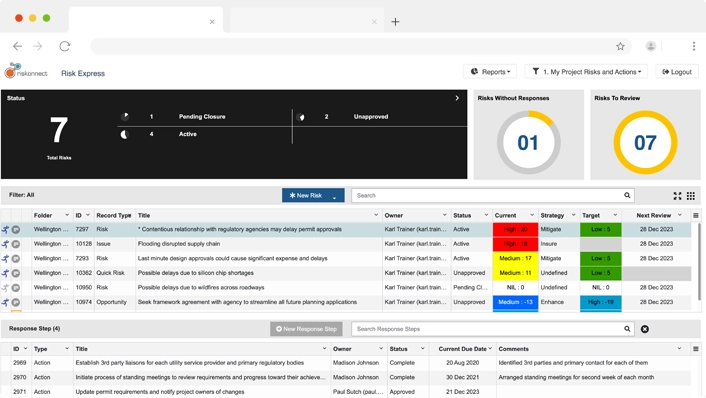
    See risks across projects, programs, and portfolios – and quickly aggregate the data using custom filters.
  • Schedule and Cost
    Impact Analysis
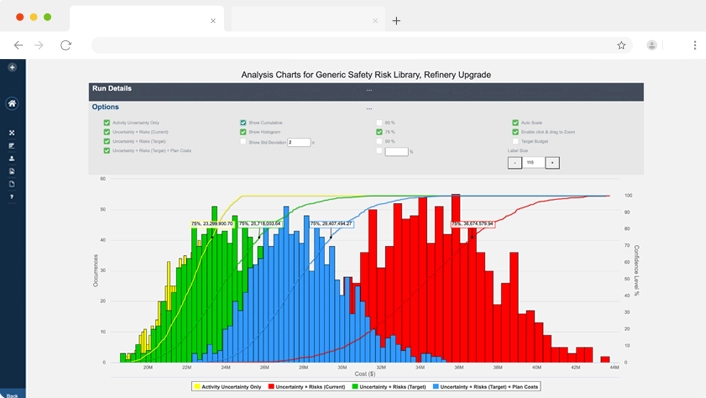
    Remove uncertainty from projects with powerful risk cost and schedule Monte Carlo risk analyses.
  • Risk
    Assessments
    Collect critical business threat information – with lightning fast, automated tools, -- to make the best resource and process decisions.
  • Risk Analytics
    and Insights
    Easily customize reporting and dashboards to tell your story and inform decisions.

ERM Demo Video

Elbit America


ARM has matured our risk management program by making sure that the practitioners know it can give them analytics with which to take proactive actions to mitigate risks or exploit opportunities. It has also allowed our leadership to have business intelligence information so that they can understand what an individual program’s risks or opportunities may be doing to their overall portfolio.

Steve Lundquist, Elbit America

Los Alamos National Laboratory


The single, best feature that Active Risk Manager brings to me as a manager is its single source of truth and the ability to propagate that across the organization very quickly and very efficiently without having to do multiple transfers and data loads.

Drew Slaton, Director of Risk Management for the U.S. Nuclear Weapons Program, Los Alamos National Laboratory

Transport for London


Riskonnect has enabled a culture of risk thinking that wasn’t there before. The organization now sees risk management as a value-add, not just a box-ticking exercise.

Ajay Patel, Head of Risks – Projects and Programmes, Transport for London

Windsor-Detroit Bridge Authority 


My favorite capability with ARM is filtering. When I’m in meetings, I can pull something up and help people think of something that they’re not thinking of. And I love the reporting. Once we have a custom report built, it can be run in under a minute. I like being able to do that part of my job very quickly and making everyone else’s lives easier.

Sam Crebolder, Manager, Project Controls, Windsor-Detroit Bridge Authority

U.S. Army 


ARM is helpful throughout the whole lifecycle, from the risk identification level all the way up to the PEO MS leadership level.

Tara Williams, Risk Management Database Administrator, U.S. Army

Ranstad
Los_Alamos_National_Laboratory_logo
Transport-for-London-Logo-color
Windsor-Detroit-Bridge-Authority-Logo
US-Army-Logo

Understand the Big-Picture Context of

What’s Happening on the Ground

If you only view individual risks to each project, how are you supposed to see important connections between risks that impact multiple projects – or roll up critical risk data into a board report? Riskonnect’s project risk management software helps you understand risk at the project, program, and enterprise levels.

  • Use the same risk register to seamlessly manage risk from project to enterprise level.
  • Identify emerging risks and trends across projects.
  • Easily collaborate on decisions to ensure that project goals are met on schedule and on budget.
  • Show collaborators relevant information based on security controls, not necessarily every data point.
Get the Most Out of
Limited Resources

How much should you set aside for contingencies? Riskonnect’s project risk management software uses sophisticated analytical tools to help you confidently predict project costs, time frame, and variability.

  • Capture data from construction managers, engineers, and other non-risk professionals with an interface designed to be intuitive enough for anyone to use.
  • Optimize resource allocation to ensure your contingency fund provides a reasonable cushion without wasting resources.
  • Understand how risk affects the bottom line so your money can be effectively budgeted.

Stay on Track for

Successful Completion

Feeling the pressure to meet strict specifications on schedule and budget? Riskonnect’s project risk management software automates every step of the risk lifecycle to help you proactively manage risks and successfully complete projects.

  • Streamline administrative tasks and easily make configuration changes like adding scoring schemes, modifying the folder structure, and creating new record options.
  • Use API integrations to seamlessly connect your risk data with other systems, including data warehouses and visualization tools.
  • Adjust project schedules based on risk data to minimize unanticipated costs and schedule slippage.
  • Maintain a library of past risk experience data and lessons learned to guide future projects.
Meet Special
Industry Requirements

Riskonnect’s project risk management software offers both secure cloud hosting and on-premises configurations to meet the exact hosting and security requirements of certain industries.

  • Standard frameworks – including ISO 31000, COSO, PMBOK, GAO
  • Industry frameworks – including DOD RIO guide, OMB A-123, OMB A-11, FAA risk management policy

Get Started with These Helpful Resources

EBOOK
Seven Risk Management
Habits for Successful Projects
What makes one project successful and another fail? The answer often lies in the way project risks are managed. This ebook dives into seven habits for managing risk that will help your projects stay on track for successful completion.
CALCULATOR
Riskonnect Active
Risk Manager ROI Calculator
Take five minutes and answer 15 questions to find out how much you could save with Riskonnect’s ARM software.
RFP TEMPLATE
Starting an RFP process for
project risk management software?
Download Riskonnect’s list of the most critical questions on project risk management-related questions solutions and customize it to suit your needs.

Expand Your Project Risk Management Program

with Other Riskonnect Solutions

Enterprise
Risk Management
Combine insurable and noninsurable risks so you can anticipate, assess, mitigate, and monitor every threat from every corner of the organization.
Third-Party
Risk Management
Collect all vendor information – including agreements, contracts, policies, and access credentials – into one place to efficiently monitor suppliers throughout the entire relationship.
Business Continuity
& Resilience
Prepare for threats and minimize disruption to operations.

Start anywhere. Expand everywhere.

Industry Recognition for Riskonnect

Redhand Advisors Forrester Wheelhouse Advisor

Start partnering with Riskonnect today.
Find out how Riskonnect can transform the way you view risk.

Quick Answers to Your Project Risk Management Software Questions

Project risk management software is a platform to manage risks to keep projects on schedule and on budget. It offers sophisticated analytics to predict project costs, contingencies, time frame, and variability. The software saves time and money by optimizing resources and fostering collaboration. And it makes it easy to see connections between risks that impact multiple projects and roll that data up for an enterprise view.

Project risk management software offers a variety of applications – like bowtie cause-and-effect analysis, job safety analysis, risk assessments, and schedule and cost impact analysis – to help you optimize resources and make more effective decisions.

The answer to this question depends on the number, size, and complexity of your projects. Companies with a limited number of smaller projects might find spreadsheets a perfectly adequate tool. As the number and size of projects grows, however, so does the amount of data and insight needed to effectively manage those risks.

You will likely benefit from project management technology if you have numerous complex projects or are struggling to keep your projects on track. Project risk management software helps you understand the upstream and downstream impacts of risks so you can understand risk at every level to successfully complete projects.

.

Riskonnect’s flexible model allows you to start anywhere and go everywhere. You can build a solution that fits your needs today – and easily add and upgrade as your business grows and changes.

Riskonnect is designed to seamlessly connect data from multiple sources inside and outside your organization. We also offer APIs (application programming interface) to easily import and export data and out-of-the-box integrations with specialized partners to help you get the most from your data as efficiently as possible.

Pricing depends on the size and complexity of the project and how much customization you require. We offer three industry-leading implementation options at different price points to fit your budget, while achieving your business objectives as quickly as possible.

General project management software — tools like Jira, Microsoft Project, or Asana — focuses on task tracking, timelines, resource allocation, and delivery milestones. Project risk management software focuses specifically on identifying, assessing, and managing the risks that could cause a project to miss those milestones or exceed its budget. The two capabilities are complementary rather than interchangeable: you need project management to plan and track execution, and you need project risk management to anticipate what could go wrong and take proactive action before it does. The distinguishing features of project risk management software are the analytical depth — Monte Carlo simulation for schedule and cost uncertainty, bowtie cause-and-effect analysis, risk register management across a portfolio of projects — and the ability to roll project-level risk data up to program and enterprise views that general PM tools don’t provide.

Monte Carlo simulation is a quantitative risk analysis technique that models the range of possible project outcomes — cost, schedule, or both — by running thousands of simulated scenarios based on the probability distributions assigned to individual risk events. Rather than producing a single point estimate (“this project will cost $10 million and complete in 18 months”), Monte Carlo analysis produces a probability distribution of outcomes (“there is a 70% probability that the project completes within 22 months and $11.5 million”). This is far more useful for decision-making: it allows project sponsors to understand the true range of uncertainty, set contingency reserves at a defensible confidence level rather than a rule-of-thumb percentage, and identify which risks have the greatest influence on overall outcomes. Riskonnect’s project risk management software includes schedule and cost impact Monte Carlo analysis as a core capability.

A bowtie diagram is a risk visualization technique that maps the causal pathways leading to a central risk event (the “knot” of the bowtie) on the left side, and the potential consequences of that event on the right side. It shows both the preventive controls that reduce the likelihood of the risk event occurring and the mitigating controls that reduce the impact if it does. In project risk management, bowtie analysis is particularly useful for complex, high-consequence risks where understanding the full causal chain — and the effectiveness of controls at each point — is essential for prioritizing risk treatment. Riskonnect’s bowtie cause-and-effect analysis capability allows project risk teams to map these causal pathways visually, identify critical controls, and assess where control gaps create the most exposure.

A risk register is the central repository for all identified risks associated with a project, program, or portfolio — the primary working document of the project risk management process. Each entry typically captures the risk description, the potential causes and consequences, a probability and impact assessment, the current risk owner, the planned response or treatment strategy, and the current status of any mitigation actions. In project risk management software, the risk register is more than a static document: it’s a live database that can be filtered and aggregated across projects to identify trends, surfaced in heat map visualizations, linked to schedule and cost models for quantitative analysis, and rolled up into program and portfolio risk reports for leadership. Riskonnect supports risk registers across projects, programs, and portfolios with custom filtering and aggregation that allows risk data to be viewed at any level of the organizational hierarchy.

Project risk management software has its deepest penetration in industries where projects are large, long-duration, technically complex, and have significant consequences for cost overruns or schedule slippage. Defense and aerospace programs — where cost and schedule overruns can have national security and contractual implications — are among the heaviest users, with requirements often specified in frameworks like the DOD Risk Issue and Opportunity (RIO) guide. Major infrastructure projects including transportation, energy, and construction depend on quantitative risk analysis to set contingency budgets and manage schedule uncertainty at scale. Government agencies managing capital programs use formal risk management frameworks including OMB A-123 and A-11. Nuclear and process industries use project risk management as part of safety case development. Riskonnect’s platform serves clients across all of these sectors and supports both standard frameworks (ISO 31000, PMBOK, COSO) and industry-specific frameworks out of the box.

Project risk management focuses on the specific threats and opportunities that affect the delivery of a defined project — on time, on budget, and to specification. Enterprise risk management takes a broader view, addressing the full range of risks that could affect the organization’s strategic objectives, including financial, operational, reputational, compliance, and strategic risks. The connection between them is important: the risks that affect a major project often have enterprise-level consequences — a significant cost overrun affects the organization’s financial position; a failed infrastructure project carries reputational risk; a defense program delay has strategic implications. When project risk data and enterprise risk data share a platform, program sponsors and executives can see how project-level risks aggregate into enterprise exposure rather than managing them in disconnected systems. Riskonnect is built for this integration — project risk feeds into the same enterprise risk management environment rather than existing as a separate tool.

A lessons learned library is a structured repository of risk data, outcomes, and insights accumulated from completed projects — capturing what risks materialized, how severe they were, what responses worked, what didn’t, and what the organization would do differently. This institutional memory is one of the most underutilized assets in most project-based organizations: without a systematic way to capture and retrieve it, the same risk blind spots tend to recur across projects because teams lack access to relevant precedent. Project risk management software supports lessons learned capture by maintaining historical risk records in a searchable format, allowing risk managers on new projects to query past experience data — “what risks affected similar infrastructure projects in this geography?” — and use that data to inform risk identification and probability assessments on current work. Riskonnect’s platform includes a library of past risk experience data specifically designed to guide future projects.

Most modern software is delivered as a cloud-hosted SaaS solution, but project risk management is one of the few categories where on-premises deployment remains genuinely important for a subset of customers. Organizations in defense, intelligence, nuclear, and certain government sectors often face data sovereignty, security classification, or regulatory requirements that prohibit or constrain the use of cloud-hosted systems for sensitive project data. Riskonnect’s project risk management platform supports both secure cloud hosting and on-premises configurations — one of the capabilities that makes it particularly well-suited for defense, government, and critical infrastructure customers with strict hosting and security requirements. This deployment flexibility, combined with support for frameworks like the DOD RIO guide and OMB A-123, is part of why the platform has a strong presence in sectors where these requirements are standard.

Individual project risk management answers the question “what risks are threatening this project?” Portfolio and program risk management answers the broader question “what risks are threatening our ability to deliver on the full portfolio of projects we’ve committed to?” When risks are managed only at the project level, common risk themes across projects go unnoticed, shared resource constraints across projects aren’t visible as a systemic risk, and program-level decisions are made without a consolidated view of aggregate risk exposure. Project risk management software that operates at the portfolio level — as Riskonnect’s does — allows risk managers and program executives to aggregate risk data across all projects, filter and compare by risk type, status, or severity, and identify the cross-project dependencies and resource conflicts that represent the highest program-level exposure. This portfolio view is particularly important for organizations managing complex, multi-project programs in aerospace, infrastructure, and defense.

The evaluation should start with your specific context: What types of projects do you manage, how complex are they, and what are your regulatory or contractual risk management obligations? A defense contractor managing programs under DOD acquisition frameworks has different requirements from a construction firm managing infrastructure projects, which in turn differs from a technology organization managing product development. Key criteria to evaluate include: depth of quantitative risk analysis capabilities (particularly Monte Carlo for schedule and cost uncertainty); support for the risk management frameworks applicable to your sector; ability to manage risk at project, program, and portfolio levels simultaneously; on-premises deployment option if your security requirements demand it; integration with schedule and cost tools; and ease of use for non-risk specialists who need to contribute risk data. The Project Risk Management RFP template provides a structured set of evaluation questions, and the Seven Risk Management Habits for Successful Projects ebook offers useful context for what distinguishes mature project risk programs from those that produce plans without outcomes.