

Threat Intelligence Software

Riskonnect’s Threat Intelligence software helps you monitor global threats in real time and respond faster and more effectively to critical events.

Boost situational awareness. Understand the real-time context of events that could affect your organization so you can move faster to secure your people and assets.

Filter out the noise. Easily customize the geographies, threat types, and severity levels to stay focused on only the events that are relevant to your organization.

Act faster with automation. Configure automatic alerts and system workflows to be triggered when specific threat conditions occur, saving time and expediting your response.
Threat Intelligence Software

Product Highlights

  • Live Threat Map
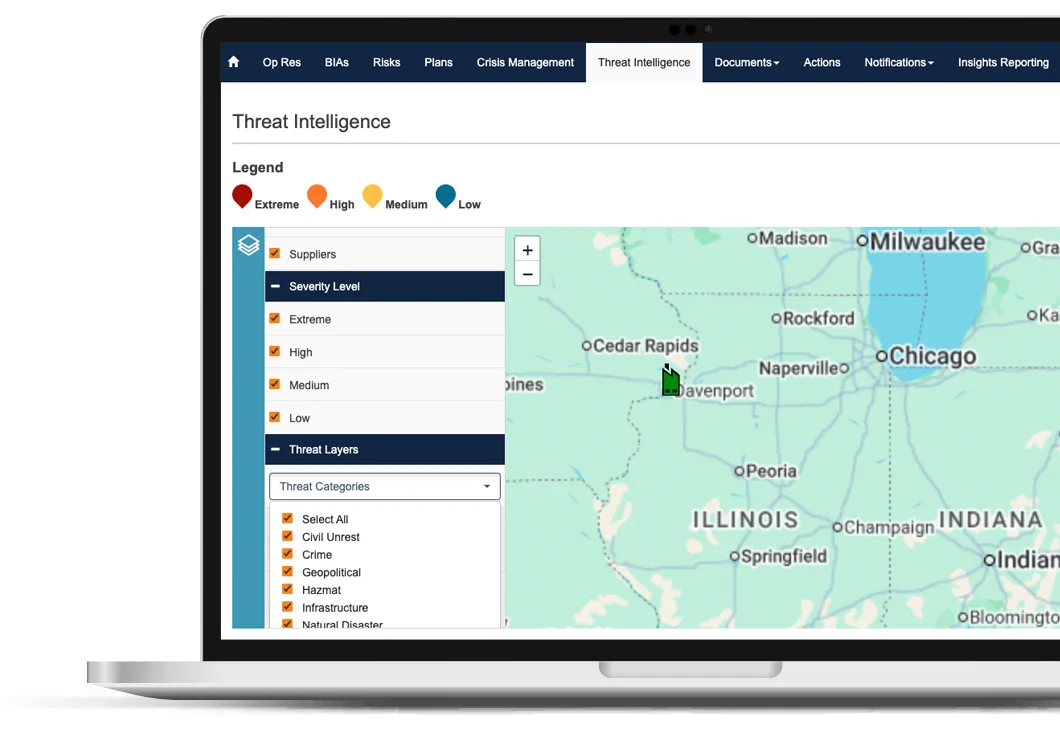
    Identify detailed information about a threat and its severity through the live feed of critical events – all without leaving the map view.
  • Threat Rules
    and Alerts
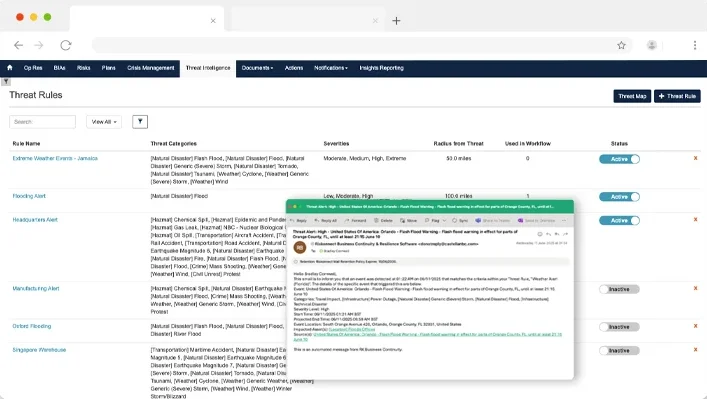
    Easily configure who should be alerted when a threat meets specific threat type, severity level, or location criteria.
  • AI-Driven /Human-
    Validated Feed
    Receive accurate, real-time information populated by OnSolve Risk Intelligence, an AI-driven threat feed that continuously monitors thousands of trusted, human-validated global data sources to detect and classify critical events quickly and accurately.


Riskonnect is so easy to understand, and the mobile app and single sign-on capabilities offer a huge advantage. When everything is hitting the fan, the last thing you want to do is wrestle with your system. Even if the power is out, we still have the plans in our pockets.

Doug Fleming, Senior Director of Environmental, Health, Safety, Business Continuity, and Sustainability, Bio-Rad

Initiate Your

Response Automatically

How much time do you waste getting your act together before you can respond to a disruption? Riskonnect’s Threat Intelligence software allows you to respond immediately with automated strategic workflows and alerts.

  • Build workflows that instantly alert stakeholders or response teams when a threat meets your specific criteria.
  • Take immediate action after reviewing a threat – like creating a new incident or sending mass notification – using the on-page actions menu.
  • Easily configure rules around who should be alerted and when.
Continuously Monitor
Your Most Critical Assets

Are you confident that the assets most critical to your organization’s operations are secure at all times? Riskonnect’s Threat Intelligence software allows you to keep tabs on everything happening around your assets to maintain business continuity.

  • Select the most important internal contacts, suppliers, and locations to monitor on the threat map.
  • Evaluate threats by low, medium, high, and extreme severity levels, and set a monitor radius from each location.
  • Manually create your own threat event to record disruptions unique to your business or processes.

Maintain Real-Time

Awareness Using a Single Solution

Are you overloaded with information from various sources through different channels? Riskonnect’s Threat Intelligence software provides a comprehensive view of your risk landscape in one place, giving you a better understanding of which disruptions are actual threats to your operations.

  • Pull in information from global data sources like news (local, national, and international), federal government agencies, curated social media feeds, and more.
  • Use a single viewpoint to see all threat categories, ranging from natural disaster to civil unrest and crime.
  • Manage all readiness and response activities in one platform to centralize your operations and reduce manual workload.

Get Started with These Helpful Resources

EBOOK
Your Guide to
Cyber Resilience
Cybercrime is one of the biggest threats to any business in any industry. This ebook explains what a comprehensive cyber resilience plan is, what’s at stake, and how to strengthen your approach.
GUIDE
The Complete Guide to Buying
Business Continuity Software
This guide demystifies the buying process with step-by-step navigation through the entire journey to help you find the best fit for your organization.
RFP TEMPLATE
Starting an RFP process for business continuity and crisis management software?
Download Riskonnect’s list of the most critical Business Continuity & Resilience-related questions and customize it to suit your needs.

Customers with Enhanced

Threat Intelligence Programs Also Use

Business Continuity
Management
Conduct business impact analyses, engage stakeholders, comply with regulations, and continuously improve your readiness.
Risk Management
Information System
Seamlessly consolidate data from multiple sources, automate routine processes, and use sophisticated analytics to turn complicated information into actionable intelligence.
Enterprise Risk
Management
Combine insurable and noninsurable risks so you can anticipate, assess, mitigate, and monitor every threat from every corner of the organization.

Start anywhere. Expand everywhere.

Industry Recognition for Riskonnect

Redhand Advisors Forrester Wheelhouse Advisor

Start partnering with Riskonnect today.
Find out how Riskonnect can transform the way you view risk.

Your Threat Intelligence Software Questions Answered

Threat intelligence software is a platform for monitoring, aggregating, and analyzing information about potential threats to an organization’s people, assets, and operations — and translating that information into timely, actionable alerts that enable a faster, more coordinated response. In the business continuity and resilience context, threat intelligence covers the full range of critical events that can disrupt operations: natural disasters, severe weather, geopolitical instability, civil unrest, infrastructure failures, crime, and security incidents. The value of threat intelligence software is the shift from reactive response — discovering that a threat has already affected the organization — to proactive awareness that allows organizations to anticipate disruptions, secure people and assets before impact, and initiate response protocols while there’s still time to make a difference. For a comprehensive overview of how this capability fits into a resilience program, see What is Threat Intelligence?

These terms can cause confusion because they describe different things. IT threat intelligence platforms — sometimes called TIPs — are cybersecurity tools designed to aggregate and analyze indicators of compromise (IoCs), adversary tactics and techniques, vulnerability data, and dark web activity to protect IT systems and networks from cyberattacks. Business continuity threat intelligence software monitors external real-world events — geopolitical threats, natural disasters, weather events, civil unrest, infrastructure disruptions, and other physical threats — to protect operational continuity and the safety of employees and assets. Riskonnect’s Threat Intelligence software is in this second category: it gives business continuity, resilience, and risk management professionals real-time situational awareness of global events that could affect their operations, people, and locations — not a tool for IT security operations centers. Both types of threat intelligence are important, and they serve complementary purposes within an integrated risk program.

A comprehensive threat intelligence platform for business continuity and resilience monitors a broad range of critical event categories simultaneously. These include natural disasters such as earthquakes, hurricanes, flooding, and wildfires; severe weather events; geopolitical incidents including conflicts, sanctions, and government instability; civil unrest, protests, and public safety incidents; infrastructure disruptions including power outages and transportation disruptions; public health events; and cyber incidents with physical operational impact. Riskonnect’s platform pulls information from global data sources including local, national, and international news, federal government agencies, and curated social media feeds — classifying threats by type, severity, and geographic location so organizations can monitor the specific risk landscape relevant to their operations rather than filtering through undifferentiated global noise.

An AI-driven threat intelligence feed continuously monitors thousands of data sources — news outlets, government agencies, social media, and other public and proprietary sources — and uses machine learning to detect, classify, and score critical events in near-real time. The AI layer does the volume work that no human team could replicate: ingesting and processing thousands of signals simultaneously, filtering out irrelevant noise, and surfacing events that meet defined relevance criteria with enough lead time to enable a proactive response. Riskonnect’s platform is powered by OnSolve Risk Intelligence, an AI-driven feed that combines automated detection with human validation — ensuring that the alerts organizations receive are both timely and accurate, rather than generating false positives that erode trust in the system over time.

A live threat map is an interactive geographic visualization of current and recent critical events, overlaid on a map of the organization’s monitored locations, assets, and personnel. It allows business continuity and security teams to see at a glance which locations are near active threats, assess the severity and proximity of events, and understand the spatial relationship between developing situations and the organization’s operational footprint. In practice, a threat map lets a resilience manager see in seconds that a Category 4 hurricane is tracking toward a distribution center, that civil unrest is intensifying near an employee travel location, or that a major power outage is affecting a region where a key supplier operates — without manually monitoring multiple news feeds. Riskonnect’s live threat map also supports on-page actions, so teams can create a new incident or trigger emergency notifications directly from the map view without switching systems.

Threat rules are automated logic configurations that trigger an alert or initiate a workflow when a threat event meets specific predefined criteria — such as a threat occurring within a defined radius of a monitored location, crossing a severity threshold (low, medium, high, extreme), or falling into a specific threat category. Configuring rules allows organizations to focus their attention and response capacity on the threats that are genuinely relevant to their operations rather than being overwhelmed by global event volume. The practical result is that the right people are notified at the right time with the right level of urgency — automatically, without requiring a team member to monitor feeds continuously. Riskonnect’s platform allows organizations to configure rules around geography, threat type, and severity, and to specify exactly who should be alerted and through which channels when those conditions are met.

Threat intelligence is most valuable when it’s directly integrated with an organization’s business continuity plans and crisis management workflows rather than operating as a standalone monitoring dashboard. When a threat event is detected that meets the organization’s alert criteria, the response shouldn’t require manually informing the BCM team, pulling up a separate plan document, and drafting communications from scratch. Riskonnect’s threat intelligence capability is built into the same platform as its business continuity management and crisis management modules — so detecting a relevant threat can automatically trigger a workflow to activate the appropriate business continuity plan, create a new incident, and send emergency notifications to the response team, all from a single platform. This integration is what transforms threat monitoring from situational awareness into operational resilience.

A monitor radius is a configurable geographic perimeter defined around a specific asset, facility, or location — for example, setting a 50-mile monitoring radius around a manufacturing plant or a 10-mile radius around a hotel where employees are traveling. Threat events occurring within the defined radius trigger the alert and notification rules configured for that location. Organizations can define different radius sizes for different locations based on the type of threat, the nature of the asset, and the lead time needed to take meaningful protective action. For most natural disaster threats — hurricanes, wildfires — a larger radius is appropriate because impact can be felt far from the epicenter. For localized incidents like crime or civil unrest, a tighter radius ensures notifications are genuinely relevant rather than generating alarm for distant events. Riskonnect supports configurable monitor radii for each monitored location, supplier, and internal contact.

Any organization with a meaningful geographic distribution of employees, assets, facilities, or suppliers benefits from real-time threat intelligence monitoring. The need is most acute for organizations with operations in multiple countries or regions with varying political and environmental risk profiles; organizations with business travel programs that put employees in locations subject to geopolitical or safety risks; companies with supply chains that depend on geographic concentrations of suppliers; and organizations in sectors where operational continuity is critical — financial services, healthcare, energy, logistics, and critical infrastructure. Essentially, the more locations, assets, and people an organization has to protect, and the more severe the consequences of a disruption to any of them, the greater the value of moving from reactive to proactive threat awareness with a dedicated leading threat intelligence solution.

The evaluation should start by distinguishing between what you need: cybersecurity threat intelligence (IoCs, adversary TTPs, dark web monitoring) versus operational and physical threat intelligence (critical events, natural disasters, geopolitical threats) — or both, in which case they’re different tools serving different teams. For operational threat intelligence in a business continuity context, the key criteria are feed quality and accuracy; global coverage across all threat categories relevant to your industry and geographies; ability to customize monitoring by location, threat type, and severity; integration with your BCM, crisis management, and emergency notification workflows; automation capabilities for alert routing and response initiation; and the ability to track and manage all readiness and response activities in a single platform. Riskonnect’s BCM and resilience RFP template covers threat intelligence requirements as part of the broader resilience program evaluation — a practical starting point for organizations building out or upgrading their top threat intelligence platform.