
Internal Controls Management Software

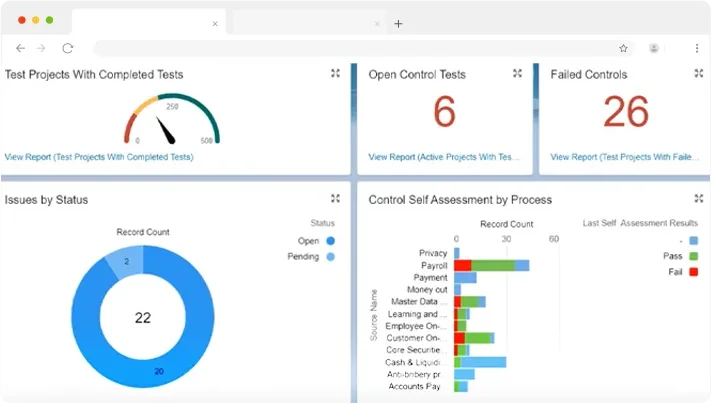
Riskonnect’s Internal Controls software offers a structured, automated approach to test your controls, provide operational transparency, and demonstrate regulatory compliance.

Simplify regulatory compliance. Confidently demonstrate adherence to control testing requirements.

Make informed decisions. Refine operational and financial strategies with precise measurements and insight.

Empower employees. Enhance employee training and awareness to ensure everyone – including remote workers – is equipped to complete control testing.
Internal Controls Management Software

Internal Controls Software

Product Highlights

  • Control Testing
    Identify and fix noncompliance issues in advance of an external audit.
  • Dashboards
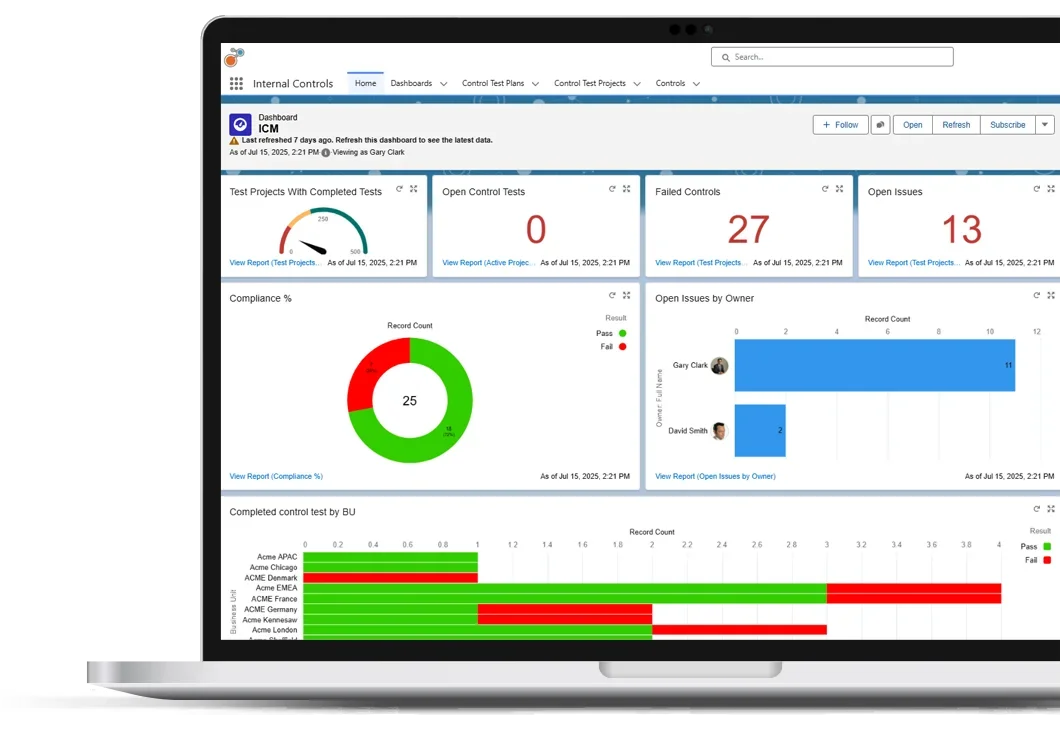
    Track, manage, and report on review cycles configured to your own processes.
  • Documentation
    Access evidence and documentation in one, organized place.
  • Planning and
    Scoping
    Specify project scope and simplify scheduling to run testing parallelly or consecutively.
  • Reviews and Signoff
    Capture review notes and approvals for easy tracking.
  • Risk-and-Control
    Matrix
    Consolidate risks, controls, and processes in one, easily accessible place for transparent assurance activity.
  • Reporting & Analytics
    Improve decision-making around risk and control data with powerful analytics and intuitive report design tools.


We need to see many different aspects of risk, from minute detail to board-level insight. It can be a minefield. The solution provided by Riskonnect has enabled our framework to make that happen.

Dan Maclennan, Group Risk Director, BT

Simplify Regulatory

Compliance

Fighting to keep up with regulations that are growing in number and complexity? Riskonnect’s Internal Controls software streamlines tracking and testing of controls to efficiently manage multijurisdictional requirements – and help you avoid hefty fines.

  • Easily schedule and manage control tests.
  • Discover and internally address regulatory noncompliance in advance of external audits.
  • Formalize compliance processes for consistency.
  • Boost adoption with a user-friendly interface.
Make Informed
Decisions

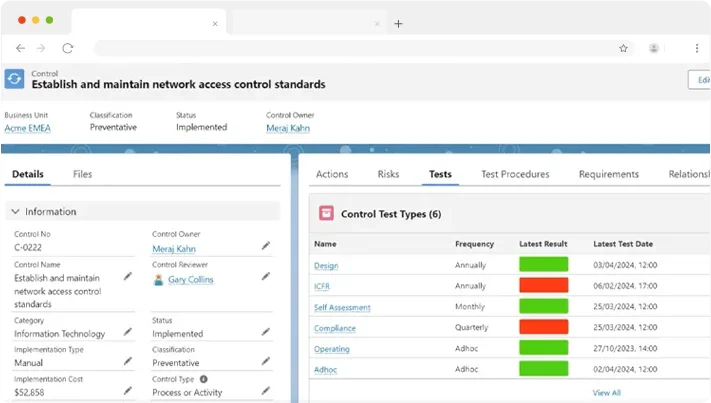
Are you afraid of being blindsided by a failure undetected by ad-hoc, spreadsheet-based control testing? Riskonnect’s Internal Controls software consistently and accurately measures controls and connects results with your broader GRC program for better visibility – and decisions.

  • Analyze control performance for deeper insight.
  • Use data-driven strategies to align with financial and operational goals.
  • Implement robust controls to manage risks effectively.

Empower

Employees

Is the shift to remote/hybrid work adding to your compliance headaches? Riskonnect’s Internal Controls software helps you track training and instill internal accountability across the organization.

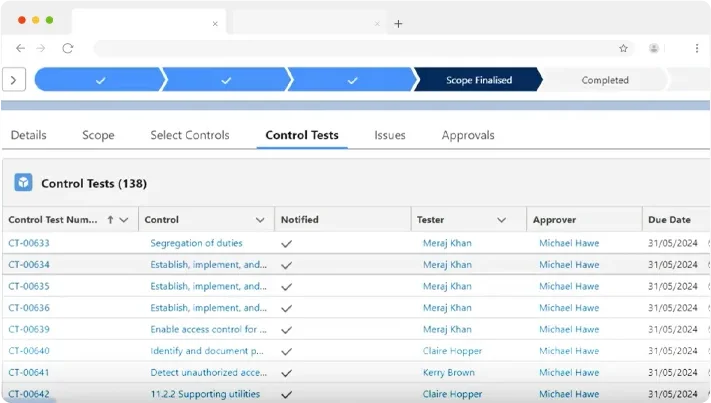
  • Define control testing projects with a distinct scope that can be run in parallel or consecutively.
  • Complete control testing via a flexible allocation of suitable test procedures.
  • Foster a culture of responsibility and compliance at all employee levels.
Get Started with These Helpful Resources


EBOOK
Transforming Compliance from
Check-the-Box to Champion
This guide will show you how to stay on top of endless regulatory change – and champion the organization’s future.
EBOOK
The Complete Guide to Buying Risk Management Software
This guide demystifies the buying process with step-by-step navigation through the entire journey.
RFP TEMPLATE
Starting an RFP process for internal controls management software?
Download Riskonnect’s list of the most critical questions and customize it to suit your needs.

Customers with Enhanced

Internal Controls Management Programs Also Use

Third-Party
Risk Management
Collect all vendor information – including agreements, contracts, policies, and access credentials – into one place to efficiently monitor suppliers throughout the entire relationship.
Compliance
Aggregate all corporate and legal policies, procedures, and requirements from across the organization into one centralized location.
IT Risk
Management
Identify your top IT, cyber, operational resilience, and other technology risks to minimize the financial impact.

Start anywhere. Expand everywhere.

Industry Recognition for Riskonnect

Redhand Advisors Forrester Wheelhouse Advisor

Start partnering with Riskonnect today.
Find out how Riskonnect can transform the way you view risk.

Your Internal Controls Software Questions Answered

Internal controls are the policies, procedures, and activities that an organization puts in place to manage risk, safeguard assets, ensure the reliability of financial reporting, and achieve compliance with applicable laws and regulations. They include both preventive controls — designed to stop errors or fraud from occurring in the first place — and detective controls — designed to identify problems after they occur so they can be corrected. Every organization has some form of internal controls whether formally documented or not; the question is whether those controls are consistently applied, demonstrably effective, and visible enough for management, auditors, and regulators to rely on. As regulatory requirements multiply and audit expectations rise, organizations that manage controls through spreadsheets and informal processes increasingly find that they can’t produce the evidence of control effectiveness that compliance and governance require.

Internal controls management software is a platform for designing, documenting, testing, and demonstrating the effectiveness of an organization’s internal controls. It centralizes the control library — the inventory of all controls the organization relies on to manage its risks — alongside the processes, regulations, and risks each control addresses. It automates control testing schedules and workflows, captures evidence of testing results, tracks remediation of identified deficiencies, and generates the reports that management, internal audit, external auditors, and regulators use to assess control effectiveness. The core value is a shift from ad hoc, spreadsheet-based control management — where testing happens inconsistently and evidence is scattered across files and email — to a structured, auditable program where every control has a documented owner, a testing record, and a clear status.

A risk-and-control matrix (also called an RCSA — Risk and Control Self-Assessment — in some contexts) is a structured mapping that connects identified risks to the specific controls designed to mitigate them, and the business processes those controls operate within. It’s the foundational document of any internal controls program, providing the explicit link between what can go wrong (the risk), what is in place to prevent or detect it (the control), and where in the organization the control applies (the process). Internal controls software uses the RCM as its organizing structure: every control test, every deficiency finding, and every remediation action is anchored to a specific risk-control-process relationship, making it possible to see at a glance where control coverage is strong and where it’s thin. Riskonnect’s platform consolidates risks, controls, and processes in a single, easily accessible risk-and-control matrix that provides transparent assurance activity across the organization.

The Sarbanes-Oxley Act (SOX) requires public companies to establish and maintain an adequate internal control structure over financial reporting (ICFR) and to assess its effectiveness annually. Section 404 of SOX is the most operationally demanding provision: it requires management to document and test key financial controls, assess any material weaknesses, and have that assessment reviewed by external auditors. The SOX compliance process — scoping, documentation, testing, deficiency management, and reporting — is one of the most resource-intensive annual exercises many finance and compliance teams undertake. Internal controls software significantly reduces this burden by providing the documentation framework, testing workflows, evidence management, and reporting capabilities that SOX requires, while also identifying and internally addressing control gaps before external auditors find them. For more on how to approach this strategically, see SOX Compliance: Turn a Burden into a Bonus.

Control testing is the structured process of evaluating whether a specific control is operating as designed — whether it’s actually preventing or detecting the risk it’s supposed to address. Testing methods vary by control type: automated controls in IT systems can often be tested by querying transaction data; manual controls require sampling and review of evidence that the control was performed; hybrid controls combine automated processing with manual oversight steps. Common types of controls that require testing include IT general controls (access management, change management, backup and recovery), financial reporting controls (account reconciliation, journal entry review, approval workflows), compliance controls (regulatory reporting, license management, trade controls), and operational controls (physical security, segregation of duties, quality assurance processes). Internal controls software supports testing by scheduling test procedures automatically, routing test assignments to appropriate owners, capturing evidence and sign-offs in a centralized record, and flagging control failures for remediation follow-up.

A control deficiency exists when a control is missing, poorly designed, or not operating effectively — leaving a gap in the organization’s protection against a specific risk. Deficiencies are typically classified by severity: a deficiency is a gap in the control environment that doesn’t rise to the level of a material weakness; a significant deficiency is more serious, representing a meaningful gap that warrants attention by those responsible for financial oversight; and a material weakness is a deficiency or combination of deficiencies that creates a reasonable possibility that a material misstatement in financial statements won’t be prevented or detected. The classification matters because it determines what action is required, what disclosures may be needed, and how urgently remediation must be completed. Internal controls software manages the deficiency lifecycle by tracking findings from identification through management response, remediation planning, action completion, and retesting to confirm the deficiency has been resolved.

Scoping is the process of determining which controls will be tested, how extensively, in a given testing cycle — balancing coverage against available resources and focusing attention where the risk is greatest. Not every control in the control library needs to be tested every year with equal depth; risk-based scoping prioritizes high-risk controls, controls that failed in prior periods, controls over financial statement areas with high materiality, and controls that regulators have specifically focused on. Internal controls software supports scoping by allowing teams to define testing projects with a distinct scope, schedule tests to run in parallel or consecutively based on dependencies and resource availability, and assign procedures to the appropriate testers. Riskonnect’s planning and scoping capability simplifies the scheduling complexity that arises when multiple control tests are running simultaneously across different business units and functional areas.

These two capabilities are deeply complementary but serve distinct functions. Internal controls management software manages the controls themselves — designing them, documenting the risk-control-process mapping, scheduling and executing control tests, tracking deficiencies, and generating evidence of control effectiveness on an ongoing basis. Internal audit software manages the audit engagements that evaluate the controls — planning and scoping audits, conducting fieldwork, managing workpapers, reporting audit findings, and tracking remediation. The distinction is ongoing management versus periodic evaluation: controls management is a continuous operational process; internal audit provides independent periodic assurance. When both run on the same platform, internal audit has direct access to the controls documentation and testing history maintained by the controls management function — which strengthens the quality and efficiency of audit work and reduces duplication. Riskonnect’s Internal Audit software is built to work alongside Internal Controls Management for exactly this reason.

Many regulatory frameworks impose explicit requirements for internal controls — not just as a general expectation of good governance, but as a specific compliance obligation with documented testing and reporting requirements. SOX Section 404 is the most prominent example in financial reporting, but similar control requirements exist in healthcare (HIPAA), financial services (SOX, Basel III, DORA), data privacy (GDPR), government contracting (DFARS), and many other sectors. Internal controls software supports multijurisdictional compliance by mapping controls to the specific regulatory requirements they satisfy, tracking which regulations apply to which processes and controls, and generating the compliance evidence and reporting that regulators and external auditors require. Riskonnect integrates internal controls management with its compliance software so that regulatory obligations and control effectiveness are visible in the same environment — reducing the risk that a compliance gap exists because a required control was never implemented or hasn’t been tested.

Internal controls are the operational layer of a GRC program — the specific mechanisms that translate risk management strategy and compliance obligations into day-to-day activities and safeguards. Without effective controls, risk assessments are theoretical and compliance obligations are aspirational. When internal controls management is integrated with enterprise risk management, the controls an organization maintains can be directly linked to the risks in the risk register — so it’s visible which risks have adequate control coverage and which have gaps. When it’s integrated with compliance, controls can be mapped to the regulatory requirements they satisfy. When it’s integrated with internal audit, control testing results feed directly into audit planning and workpaper evidence. Riskonnect’s GRC platform is built for this integration — internal controls management shares the same environment as ERM, compliance, and internal audit, so the organization’s full GRC picture is coherent rather than assembled from disconnected tools.