

Business Continuity & Resilience Software

Riskonnect’s business continuity and resilience software helps you prepare for threats and minimize disruption to operations.

Instantly access dynamic business continuity plans. Manage business continuity and operational resilience from one centralized location that automates regular reviews and approvals.

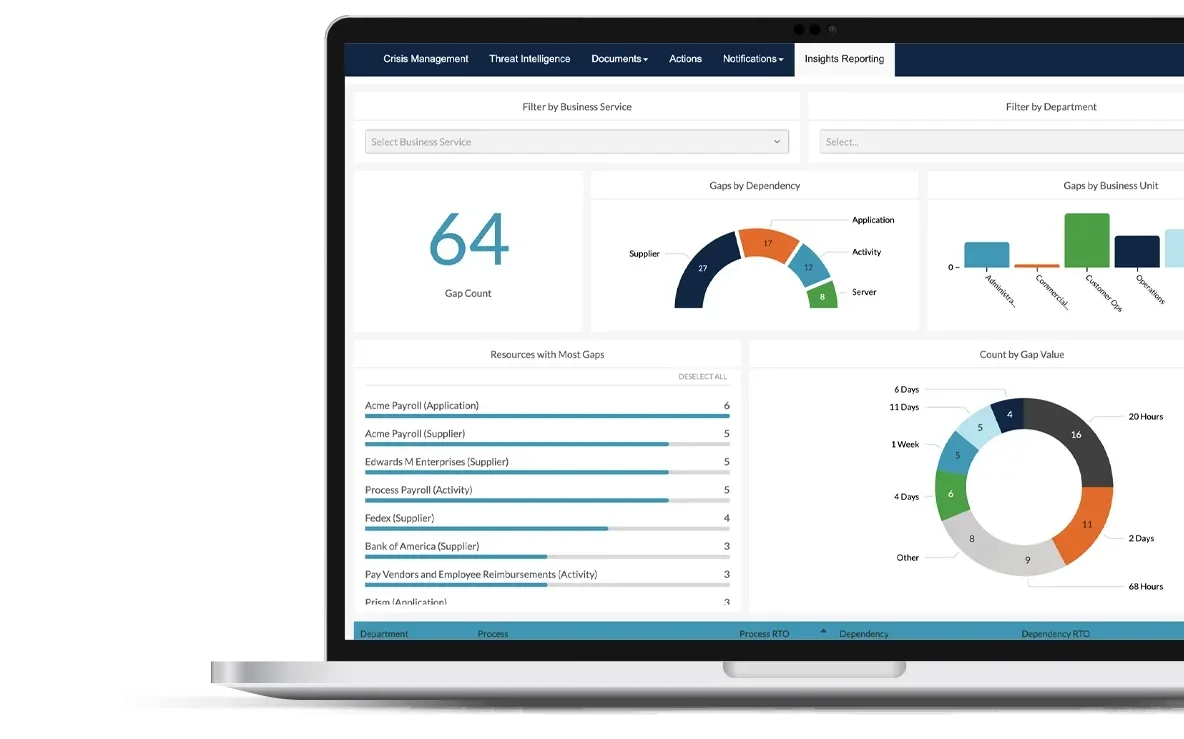
Replace uncertainty with confidence. Identify hidden vulnerabilities and program gaps that could derail your response and recovery strategies.

Effectively respond to a disruption. Secure your response team in real time with live situation reporting, online plan activation, and timely communication.
Business Continuity & Resilience Software

Product Highlights

Get a complete, automated planning experience in one platform to integrate business continuity into your everyday operations. LEARN MORE

Strategically scope your program, establish impact tolerance, and create an end-to-end digital model of the organization to quickly achieve compliance and mitigate disruptions. LEARN MORE
Communicate securely across the organization or within a team throughout a crisis or disruption. LEARN MORE
Centralize critical information flows during an incident to promptly secure your response team, activate response plans, and get stakeholders on the same page. LEARN MORE
Monitor global threats in real time and respond faster and more effectively to critical events. LEARN MORE
Tap into Riskonnect’s expertise to develop a world-class program tailored to you. LEARN MORE
Generate business continuity plans with the power of AI. LEARN MORE

BCR Demo Video

AI in Business Continuity & Resilience

Bring data from plans, threats, incidents, and operations into a clear, real-time picture to see patterns, anticipate disruptions, and act before they become crises.

Threat Intelligence Stress Testing

Run scenario-based simulations using threat intelligence data to test business continuity and resilience plans under realistic conditions.

Business Resilience Agent

Analyze stress test results and provides recommended corrective actions to address weaknesses in resilience plans.



One of the big features for Riskonnect is that it’s a cloud solution. I can get to it from any device with a signal. This empowers our leaders, particularly those recovery team members that might not be looking at the plan every day. Being able to access tasks on the mobile app really helps in eliminating single points of failure.

Brad Henske, Director of Business Continuity and Resilience, Carilion Clinic

Expose Hidden Vulnerabilities

Before They Take You Down

Has business as usual lulled you into a false sense of security? Riskonnect’s Business Continuity & Resilience software helps you cut through the noise to identify – and eliminate – hidden vulnerabilities.

  • Create an end-to-end digital model of your organization to understand obligations, dependencies, and vulnerabilities.
  • Identify plausible disruption scenarios and model the impact on important business services.
  • Stress-test your plans against disruption scenarios to expose gaps in response and recovery methods.
Close the Gap Between Readiness and Response

Close the Gap Between
Readiness and Response

When a crisis hits, who has time to dig through files to find the current response plan? Riskonnect’s Business Continuity & Resilience software provides built-in crisis management and emergency notification tools, so you can confidently respond when it matters most.

  • Instantly activate your response plans, track and manage tasks, and collaborate securely with encrypted chat.
  • Drive emergency communications with embedded, enterprise-grade notification tools.
  • Manage crisis coordination and emergency notifications straight from your mobile device.

Focus on Strategy,

Not Paperwork

Does strategic thinking get edged out by entering data into spreadsheets and other administrative tasks? Riskonnect’s Business Continuity & Resilience software automates your program and integrates business continuity into your everyday operations, giving you more time to tackle important strategic projects.

  • Drive efficiency by leveraging a single, user-friendly system for operational resilience, business continuity, crisis management, and emergency notifications.
  • Seamlessly share information and reduce human error by connecting to gold-source data repositories.
  • Streamline administrative tasks with prebuilt functionality, workflows, and templates based on best practices.

Stay Ahead of

Emerging Regulations

Struggling to keep your resilience plans up to date with new regulations? Riskonnect’s Business Continuity & Resilience software helps you comply with ever-increasing regulatory requirements around preventing disruption and maintaining service continuity.

  • Leverage out-of-the-box alignment with ISO 22301, including corrective actions and management reviews.
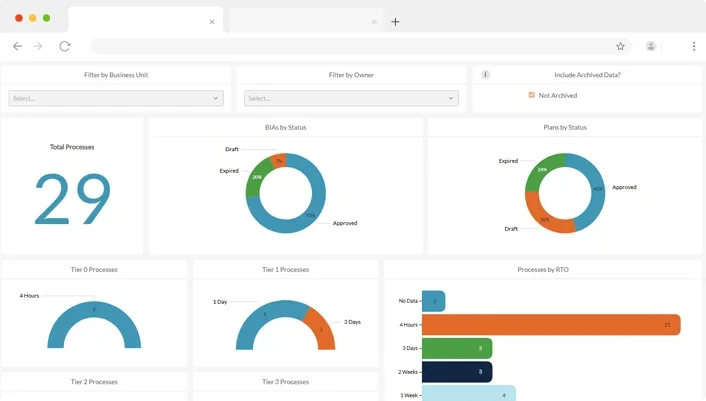
  • Develop meaningful scorecards, dashboards, and reports that summarize key performance and risk indicators for internal and external stakeholders.
  • Decrease disruption, increase readiness, and lower your risk to critical business operations, revenue, and brand.

Get Started with These Helpful Resources

GUIDE
The Complete Guide to Buying
Business Continuity Software
This guide demystifies the buying process with step-by-step navigation through the entire journey to help you find the best fit for your organization.
CALCULATOR
Calculate Your ROI for
Business Continuity Software
Take five minutes and answer 15 questions to find out how much you could save with Riskonnect’s Business Continuity & Resilience software.
RFP TEMPLATE
Starting an RFP process for
business continuity software?
Download Riskonnect’s list of the most critical business continuity software-related questions and customize it to suit your needs.

Customers with Enhanced

Resilience Programs Also Use

Enterprise Risk
Management
Combine insurable and noninsurable risks so you can anticipate, assess, mitigate, and monitor every threat from every corner of the organization.
IT Risk Management
Seamlessly consolidate data from multiple sources, automate routine processes, and use sophisticated analytics to turn complicated information into actionable intelligence.
Risk Management
Information System
Seamlessly consolidate data from multiple sources, automate routine processes, and use sophisticated analytics to turn complicated information into actionable intelligence.

Start anywhere. Expand everywhere.

Industry Recognition for Riskonnect

Redhand Advisors Forrester Wheelhouse Advisor

Start partnering with Riskonnect today.
Find out how Riskonnect can transform the way you view risk.

Quick Answers to Your Business Continuity Software Questions

Business continuity software is a tool to organize and automate an organization’s continuity and resilience activities. It aggregates all business continuity and operational resilience plans from across the organization into one centralized location to improve consistency and alignment with overall strategy. It helps you eliminate redundancies and identify gaps that could leave you vulnerable. Technology also can help prioritize actions and minimize risk by facilitating collaboration and integrating continuity into regular decision-making.

Riskonnect’s Business Continuity & Resilience software offers a variety of specialized features and functions – like emergency notifications, crisis management, and threat intelligence – to automate reviews and approvals, establish impact tolerances, achieve compliance, and communicate securely under any conditions.

Time is of the essence when a disruption hits. Organizations that view preparedness in pieces – by department, location, business unit, etc. – waste valuable time and resources figuring out what and who is impacted and what should be done about it. Software helps ensure your business continuity plans are clear, coordinated, tested, approved, and ready to go the instant something happens. Business continuity software also makes it easy to provide metrics that will assure leaders that the business can continue to operate even under disruptive conditions.

Look for business continuity software that is easy to use, accessible, reliable, and secure. Even the most casual users should be able to easily make changes and updates to plans without extensive upfront training or an annual refresher.

Riskonnect is designed to seamlessly connect risk data of all types across your organization. We also offer APIs (application programming interface) to easily import and export data and out-of-the-box integrations with specialized partners to help you get the most from your data as efficiently as possible.

Pricing depends on the size and complexity of the project and how much customization you require. We offer three industry-leading implementation options at different price points to fit your budget, while achieving your business

“Business continuity software” is the broader category — it encompasses all the tools an organization uses to prepare for, respond to, and recover from disruptions, including business continuity planning, crisis management, operational resilience, emergency notification, and threat intelligence. “Business continuity management software” is a more specific term that refers to the planning and program management discipline within that broader portfolio: the tools used to build and maintain continuity plans, conduct business impact analyses, run gap assessments, and test readiness. Organizations that need only the planning capability may evaluate BCM software specifically. Organizations that need coordinated response, crisis communication, and resilience governance across the enterprise typically need the fuller business continuity management suite.

At the enterprise level, business continuity software needs to do more than store plans — it needs to coordinate response across a complex, multi-location organization under real-time pressure. Key capabilities include: a centralized, always-current plan repository accessible from any device; automated review and approval workflows; business impact analysis tools that map dependencies from supplier to customer; crisis management and emergency notification integrated into the same platform; threat intelligence monitoring to anticipate disruptions before they materialize; resilience testing to validate plans before they’re needed; and dashboards that give leadership a real-time picture of program status and incident response. The case for integrated enterprise business continuity software is essentially the case against managing a crisis from six disconnected systems simultaneously.

Business continuity focuses on preparing specific plans to respond to and recover from defined disruption scenarios — a natural disaster, a system outage, a supply chain failure. Operational resilience is a broader, outcomes-focused discipline: rather than asking “how do we recover from this specific event?”, it asks “what are the important business services we deliver, what is the maximum tolerable level of disruption to each, and how do we build the organization’s capacity to absorb and adapt to any disruption?” Regulators in financial services — particularly under DORA and UK PRA/FCA frameworks — have pushed organizations toward operational resilience as the governing standard. In practice, a strong operational resilience program is built on the foundation of a strong BCM program, but extends further into end-to-end service mapping, impact tolerance setting, and scenario testing.

Crisis management software supports the real-time coordination function when a disruption is actively unfolding — activating response plans, securing and tasking the response team, tracking incident status, managing stakeholder communications, and maintaining a documented record of decisions and actions taken. It’s distinct from business continuity planning software, which supports the preparation phase. Organizations that manage complex incidents involving multiple teams, locations, or stakeholders — or that face regulatory requirements to demonstrate structured incident response — typically need dedicated crisis management capabilities alongside their continuity planning tools. The two functions work best when they share the same platform, so the plans built in preparation are directly activated during response without requiring manual handoff.

Traditional business continuity programs are largely reactive — they prepare for disruption scenarios identified in advance. Threat intelligence shifts the posture toward anticipation: continuously monitoring geopolitical events, weather systems, cybersecurity threats, supply chain signals, and other external risk factors to give the organization advance warning of potential disruptions. This extra lead time can mean the difference between activating a continuity plan proactively — before impact — and scrambling to respond after the fact. Riskonnect’s threat intelligence capability is built directly into the business continuity platform, so the same team that manages continuity plans also has visibility into the threat landscape that those plans are designed to address.

Business continuity and resilience programs are increasingly subject to formal regulatory requirements across industries. Financial services organizations face specific mandates under DORA, the UK’s operational resilience rules from the PRA and FCA, and requirements from banking regulators in multiple jurisdictions. Healthcare organizations must demonstrate continuity capabilities as part of accreditation. Critical infrastructure sectors face sector-specific resilience requirements. ISO 22301 provides the widely adopted international standard for BCM programs. Good business continuity software supports compliance by providing out-of-the-box alignment with these frameworks, generating the documentation and evidence regulators expect, and maintaining a continuous audit trail of plan reviews, testing exercises, and incident responses — so compliance is a byproduct of running the program well, not a separate reporting exercise.

Business continuity doesn’t exist in a risk management vacuum. The scenarios a continuity program prepares for — IT outages, natural disasters, supply chain failures, cyberattacks — are the same events that show up in the enterprise risk register as high-impact tail risks. When business continuity software is integrated with enterprise risk management and IT risk management on the same platform, risk teams can see the relationship between identified risks and continuity preparedness: which scenarios have plans, which plans have been tested and validated, and where gaps exist. Riskonnect is built specifically for this integration, connecting business continuity and risk management software so that continuity status informs the overall risk picture rather than sitting in a separate system.

Managed business continuity refers to an arrangement where an external provider — like Riskonnect’s consulting and managed services team — takes on ongoing responsibility for some or all of a client’s BCM program: plan development, maintenance, testing, and program improvement. It’s typically the right option for organizations that lack dedicated internal BCM expertise, are building or rebuilding a program from a low maturity baseline, or want to accelerate program development without hiring a full team. The advantage of managed services delivered by a software provider is that the expertise is directly integrated with the technology — the consultants who advise on your program are working within the same platform your team uses day to day. Riskonnect’s business continuity consulting and managed services offer this integrated model.

Emergency notification is the communications layer of crisis response — the capability to rapidly reach employees, response team members, and other stakeholders with alerts, instructions, and status updates during an incident. Effective emergency notification needs to be fast, reliable across multiple channels (SMS, email, voice, app), capable of targeting specific groups or locations, and integrated with the crisis management and continuity response workflows rather than operating as a separate system. Riskonnect’s emergency notification capability is built directly into the business continuity platform, so the same team activating a response plan can simultaneously trigger targeted communications to the right people — without switching tools or manually exporting contact lists under pressure.

The evaluation should start with an honest assessment of your program’s current maturity and where the gaps are. Organizations with no formal program need a platform that provides strong out-of-the-box templates, workflows, and guidance. Organizations with established programs typically need deeper integration — connecting BCM to risk management, IT risk, and compliance — and more sophisticated testing and reporting capabilities. Key evaluation criteria include: the depth of out-of-the-box content and framework alignment (particularly ISO 22301); the integration between planning, crisis management, and notification tools; mobile accessibility for response team members in the field; ease of use for casual users who aren’t BCM professionals; and implementation support. Riskonnect’s BCM RFP template is a useful starting point for structuring that evaluation.