

RMIS Software

Risk Management Information System

Riskonnect’s RMIS software gives you the data, analytics, and insight to turn risk into a strategic advantage.

Focus your time on where you can make a difference. Spend less time chasing down data and more time analysing what it means.

Communicate effortlessly from the frontlines to the C-suite. Break down silos and seamlessly share always up-to-date risk data across the organisation.

Make confident decisions boosted with Intelligent Risk. Generate actionable insights using Riskonnect’s AI-powered risk-decision engine.
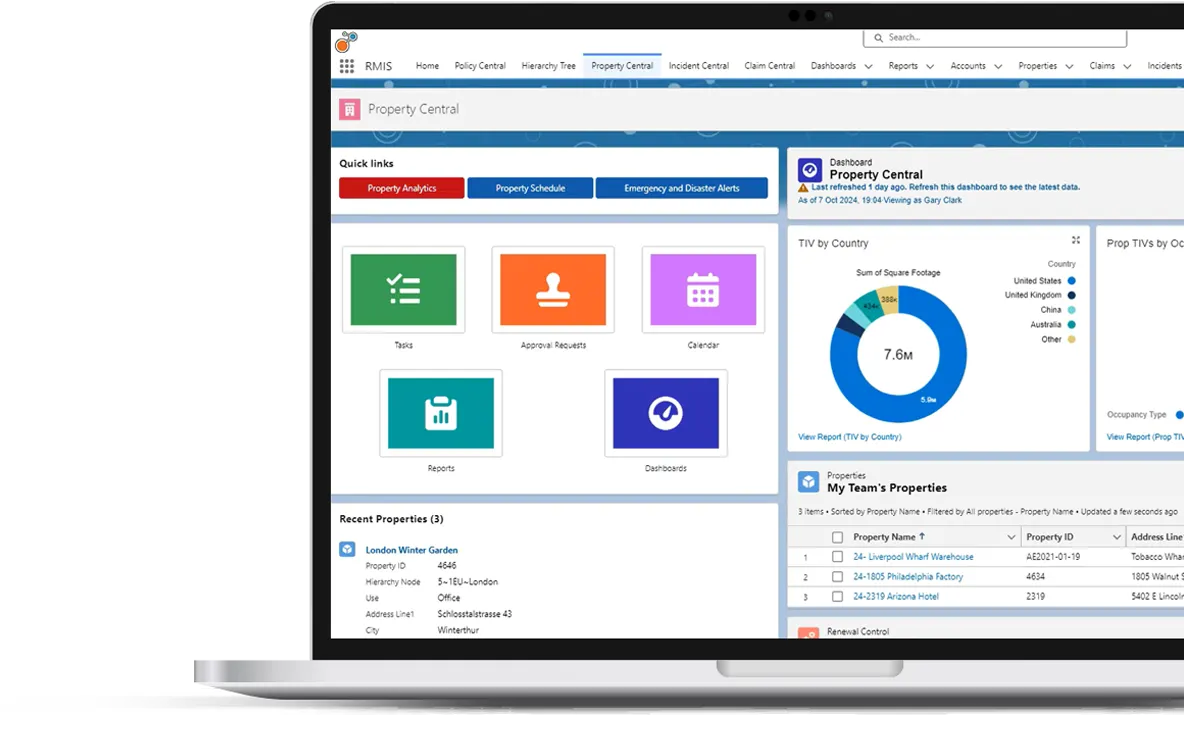
RMIS software on laptop screen

RMIS Software

Product Highlights

  • Asset & Exposure
    Management
    Gain a comprehensive view of your asset and exposure portfolio to avoid overlaps or gaps in coverage.
  • Certificate
    Management
    Streamline tracking and management of incoming certificates of insurance to reduce exposure from contractors, tenants, suppliers, and other business partners.
  • Claims
    Management
    Take charge of the entire claims process, from first notice to adjudication, payment, and subrogation. Learn more.
    Learn more.
  • Cost
    Allocations
    Accurately allocate premiums and fees based on your actual experience and methodology.
  • Environment,
    Health & Safety
    Identify risks, ensure compliance, and evaluate the effectiveness of your EHS program.
  • Incident
    Management
    Capture data right at the source to quickly and accurately get information to those who can investigate, evaluate, and act.
  • Insurance
    Management
    Track and manage all insurance policies and features, including premiums, layers, limits, deductibles, carriers, and more.
  • Renewal Value
    Collection
    Streamline insurance policy renewal by automatically collecting, consolidating, and analyzing risk and exposure data.
  • Intelligent
    Risk
    Augment human expertise with an AI-powered risk-decision engine that provides predictive insights, summarizes complex documentation, and automates workflows.
    Learn more.
  • Risk Analytics
    and Insights
    Easily customize your reporting and dashboards to tell your story and inform decisions.
    Learn more.

RMIS Demo Video

Randstad


Trey Braden at Randstad

Riskonnect has allowed us to embark on actions we’ve never had clarity on before. If no action is coming out of the data, what’s the point.

Trey Braden, Director, Risk Management, Randstad

IHG® Hotels & Resorts


Marcela Siera

Riskonnect is helping us in terms of achieving financial accuracy for payments for insurers, which is great. We have full visibility of what’s going on in terms of claims management from start to end.

Marcela Siera, Insurance Systems Manager, IHG® Hotels & Resorts

Reimagined Parking


Jeff Hauf

Anybody in the claims industry knows that the longer a claim is open, the more costly it is. With Riskonnect we now have a more efficient claims intake process and quicker triaging, helping to reduce claims duration and expenses.

Jeff Hauf, Senior Director of Claims, Reimagined Parking

Ranstad
IHG
Reimagined Parking

Reduce Costs
and Increase Profitability

Feeling the pressure to correctly anticipate what’s ahead – in less time with fewer resources? Riskonnect’s RMIS software seamlessly integrates people, systems, and data to help you make more informed decisions about risk. Your costs go down and profitability goes up.

  • Consolidate real-time risk data from multiple internal and external sources to identify trends, emerging risks, and opportunities.
  • Understand the relationships between critical risks and the impact on the organisation.
  • Seamlessly integrate data from carriers, TPAs, third-party vendors, and internal departments into one source of truth.
  • Gain strategic insights to optimise your insurance program.
  • Identify cost-savings opportunities that previously may have gone unnoticed.

Find Instant Relief
from Daily Pain Points

If you’re stuck tracking down information with endless back-and-forth emails, when are you supposed to figure out what it all means? Riskonnect’s RMIS software streamlines and automates routine processes so you can say goodbye to boring repetitive tasks and hello to delivering human-worthy insights from data you trust.

  • Save time and money by streamlining and automating processes.
  • Capture data consistently and thoroughly with standard templates, intuitive forms, and auto-filled fields.
  • Minimise human error by guiding users through the data-collection process.
  • Eliminate duplicate data entry by automatically uploading and extracting information from ACORD forms.
  • Send alerts, reminders, and progress reports automatically.
  • Communicate seamlessly using SMS text, WhatsApp, and other channels.

Make Smarter Decisions
Faster

Can you deliver the level of risk insight demanded by the C-suite? Riskonnect’s RMIS software gives you unprecedented insight into your risks and their relationships so you can quickly and confidently decide what to do.

  • Improve communication about risks across departments and with the C-suite.
  • Create easy-to-interpret reports that communicate a clear picture of your risks.
  • Instantly summarise complex, lengthy claims documents.
  • Generate actionable insights using embedded AI-powered predictive analytics models.

Get Started with These Helpful Resources

Resources-ebook-The-Top-5-RMIS-Tools
EBOOK
The Top 5 RMIS Tools
This ebook dives into the top RMIS applications and explains how they can help you become more efficient, more effective – and ultimately, lower your total cost of risk.
Resources-Assessment-Do-you-need-a-RMIS
ASSESSMENT
Do you need a RMIS?
Whether or not you need a RMIS depends on the complexity of your risks and how sophisticated your needs are. Here are 11 questions to help you decide.
RFP TEMPLATE
Starting an RFP process for a risk management information system?
Download Riskonnect’s list of the most critical RMIS-related questions and customise it to suit your needs.

Customers with Enhanced

Risk Management Programmes Also Use

Claims Management
Integrate people, systems, and claims data and automate routine processes, so you can focus on resolving even the most complex claims quickly, easily, and fairly.
Enterprise
Risk Management
Combine insurable and noninsurable risks so you can anticipate, assess, mitigate, and monitor every threat from every corner of the organisation.
Business Continuity
& Resilience
Prepare for threats and minimise disruption to operations.

Start anywhere. Expand everywhere.

Industry Recognition for Riskonnect

Redhand Advisors Forrester Wheelhouse Advisor

Start partnering with Riskonnect today.
Find out how Riskonnect can transform the way you view risk.

Quick Answers to Your RMIS Software Questions

A risk management information system – RMIS – is a software platform for collecting, managing, analysing, and reporting risk, claims, and safety information. A RMIS brings all your insured risk data together into one place to give you a clear view of your risks, the relationships, and the impact on the organisation. It saves time and improves accuracy by automating tasks and streamlining workflows. It also can reduce the stress on the risk management team, risk exposure – and your total cost of risk.

A RMIS offers a variety of applications – like certificate management, claims management, exposure management, and insurance management – to make managing risk easier, faster, and more effective.

The answer to this question depends on the complexity of your risks and how sophisticated your needs are. Companies with a limited number of locations, employees, assets, insurance carriers, and reporting needs might find spreadsheets a perfectly adequate tool. As your company grows, however, so do the risks – and the amount of data and reporting needed to effectively manage those risks.

You will likely benefit from RMIS technology if you have multiple carriers or TPAs, are struggling to gather timely and accurate data, or are unable to easily produce necessary reports. A RMIS automates data collection and validation, so you can spend your time on more valuable, strategic tasks. A RMIS also gives you complete and timely data, which can help you make smarter, faster decisions to mitigate losses – and ultimately lower your premiums.

Riskonnect’s flexible model allows you to start anywhere and go everywhere. You can build a solution that fits your needs today – and easily add and upgrade as your business grows and changes.

Riskonnect is designed to seamlessly connect risk data of all types – insurable and noninsurable – across your organisation. The software can handle vast amounts of data from numerous insurers/TPAs in multiple formats and currencies. And you can easily incorporate that data into your enterprise-level risk analysis.

Pricing depends on the size and complexity of the project and how much customisation you require. We offer three industry-leading implementation options at different price points to fit your budget, while achieving your business objectives as quickly as possible.

General risk management software — including ERM, GRC, and compliance platforms — focuses on enterprise-wide governance: identifying risks across the organisation, mapping them to controls and regulatory obligations, and reporting on risk posture to leadership. A risk management information system is specifically designed for insurable risk: the operational data associated with claims, insurance policies, certificates of insurance, exposures, incidents, and cost allocations. The primary users are risk managers, insurance professionals, and claims teams who need to manage the insurance program, track losses, and optimise premium spend. The two categories are complementary — Riskonnect offers both — but they serve different functions and different workflows. For a full explanation of what an RMIS does, see What is RMIS Software?

A comprehensive RMIS platform covers the full lifecycle of insurable risk management. The nine essential functions typically include: claims management — tracking claims from first notice of loss through adjudication, payment, and subrogation; exposure and asset management — maintaining an accurate inventory of what needs to be insured; insurance program management — tracking policies, premiums, layers, limits, deductibles, and carriers; certificate of insurance management — monitoring incoming COIs from contractors, tenants, and vendors; incident management — capturing loss events at the source before they become claims; cost allocation — distributing premiums and losses to the right business units based on actual experience; renewal value collection — streamlining the data gathering process at renewal; analytics and reporting — turning raw risk data into decision-ready insights; and workflow automation — reducing the manual coordination burden on the risk team.

Claims represent the most direct financial exposure in any insurable risk program, and the speed and accuracy with which they’re managed has a direct impact on total cost of risk. A top RMIS platform gives claims teams end-to-end visibility from first notice of loss through adjudication, payment, and subrogation — with all relevant documentation, communications, and status updates in one place. Workflow automation ensures the right people are notified at the right stages, reducing lag time and preventing claims from sitting idle. AI-assisted capabilities can summarise complex claims documents instantly and surface predictive insights about likely outcomes — helping adjusters and risk managers prioritise their attention and intervention on the claims that need it most.

Total cost of risk (TCOR) is the comprehensive measure of an organisation’s risk-related expenditures: insurance premiums, retained losses, claims administration costs, risk management overhead, and the indirect costs of uninsured losses. It’s the metric that gives risk managers a complete picture of what risk is actually costing the business — and where the opportunities for reduction lie. An RMIS reduces TCOR by consolidating loss data to identify trends and root causes that drive premium increases; surfacing cost allocation data that creates accountability at the business unit level; streamlining claims management to reduce duration and expense; and providing the analytical foundation for negotiating more favorable terms at renewal. Without consolidated, accurate data, most organisations are managing premiums and losses reactively rather than strategically.

Cost allocation — distributing insurance premiums and loss costs to the business units, locations, or cost centres that generate them — is one of the most operationally complex functions in risk management. Done well, it creates financial accountability and incentivizes risk-reducing behaviour across the organisation. Done poorly, it creates internal friction and fails to accurately reflect where exposure actually sits. A RMIS automates this process by applying your defined allocation methodology to actual loss experience and premium data, calculating allocations accurately, and generating the reports that support internal charge-backs and budget discussions. Riskonnect’s cost allocation capability supports multiple allocation methodologies and allows risk managers to model different scenarios — so the numbers that go to finance and business unit leaders are defensible and consistently applied.

A certificate of insurance (COI) is a document issued by a vendor’s, contractor’s, or tenant’s insurer confirming that coverage is in place. Organisations that rely on third parties — contractors performing work on their premises, tenants occupying their properties, suppliers handling their products — need to verify that those parties maintain adequate insurance coverage, or they absorb the exposure if something goes wrong. Managing this manually across hundreds or thousands of certificates is error-prone and labor-intensive. An RMIS automates COI tracking by maintaining a central repository of all incoming certificates, flagging expiring coverage before it lapses, and generating compliance reports that show which third parties are out of compliance at any point in time. This capability is closely related to — though distinct from — third-party risk management in the GRC sense.

Insurance renewals require assembling comprehensive, accurate exposure data — property values, payroll figures, vehicle counts, revenue numbers, and loss histories — and presenting it to insurers and brokers in a form they can underwrite. The process is notoriously labor-intensive when done manually, pulling risk managers away from more strategic work for weeks at a time. An RMIS streamlines renewal by automatically collecting and consolidating exposure data from across the organisation, comparing current year figures against prior years to explain changes, and formatting the output for broker submission. The result is a faster, more accurate renewal process — and better-quality data that strengthens the organisation’s negotiating position with carriers.

AI is beginning to change what’s possible in RMIS in several practical ways. Predictive analytics models built into the platform can surface early warning signals in claims data — identifying which open claims are likely to develop adversely, or which business units are trending toward higher loss frequency. Natural language processing can instantly summarise lengthy claims documents, saving adjusters and risk managers significant time on routine review tasks. Workflow automation, enhanced by AI, can route claims and tasks more intelligently based on claim characteristics rather than static rules. And at the strategic level, AI-powered risk decision support — like Riskonnect’s Intelligent Risk capability — can generate actionable insights from consolidated risk data that would take a risk analyst hours to surface manually.

The traditional RMIS world — insurable risk, claims, insurance program management — and the ERM world have historically operated as separate disciplines with separate tools. The strategic case for connecting them is straightforward: insured losses are a subset of enterprise risk, and the data in an RMIS (loss trends, exposure concentrations, incident patterns) is directly relevant to the enterprise risk picture. When RMIS and ERM share a platform, risk managers can show leadership how insurable risk relates to broader strategic and operational risks — making a stronger case for the risk function’s value. Riskonnect’s platform is built specifically for this integration: insurable and noninsurable risk data share the same environment, so neither function operates with an incomplete picture. For more on the relationship, see What is RMIS and What is it For?

RMIS evaluation starts with an honest audit of your current pain points. Common triggers for evaluation include: inability to get timely, accurate loss data from carriers and TPAs; claims teams spending too much time on administrative coordination rather than resolution; difficulty producing the reports that leadership and auditors need; and a renewal process that consumes weeks of manual effort every year. From there, the key evaluation criteria are: depth of claims management functionality; quality of carrier and TPA data integration; flexibility of cost allocation methodology support; ease of reporting and analytics without IT involvement; AI capabilities for claims summarisation and predictive analytics; and the implementation approach and timeline. Riskonnect’s RMIS RFP template provides a structured framework for comparing top RMIS software vendors on the criteria that matter most in actual operation — and the RMIS Definitive Guide covers the full landscape of what to look for in a leading RMIS solution.