

Policy Management Software

Riskonnect’s Policy Management software simplifies the administration of corporate policies and procedures.

Centralise the location of all policies and procedures. Create a single source of truth by storing all of your policies in one, secure place.

Engage, collaborate, and communicate with all the right people. Automate review and approval processes through repeatable, consistent workflows.

Establish a sustainably responsible process – and minimise cost. Reduce your environmental impact and support your ESG initiatives by eliminating paper and toner, while reducing storage costs of paper policies.
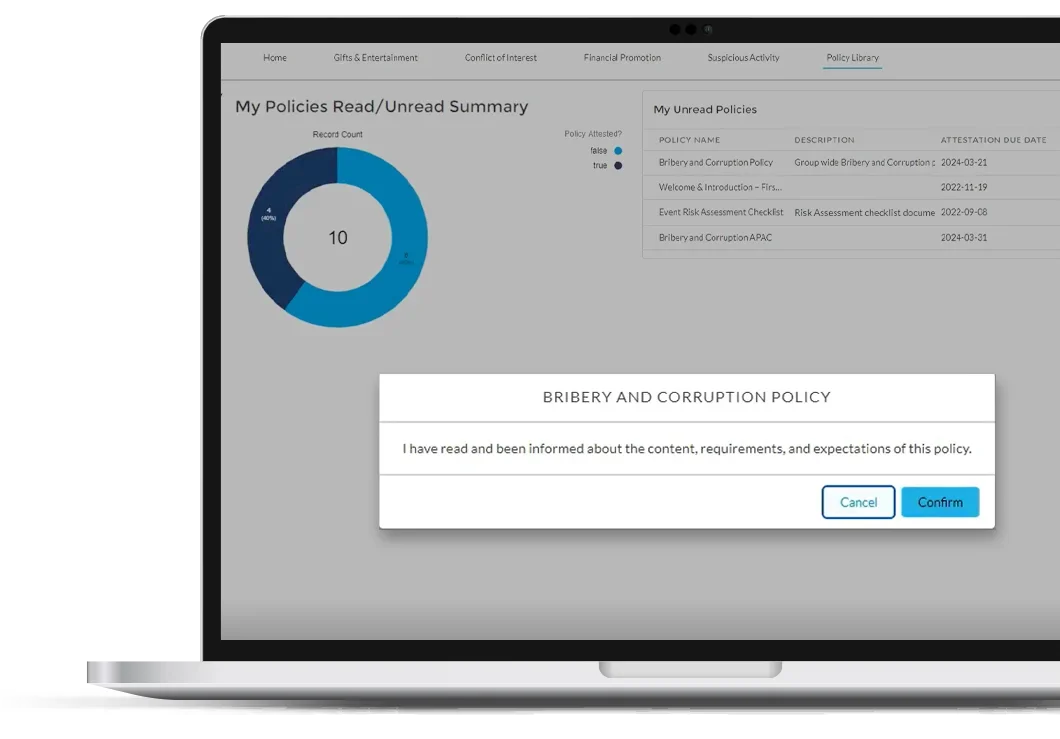
Policy Management Software

Policy Management Software

Product Highlights

  • Central Repository
    Store all documents in a single secure cloud-based location, easily accessible to all.
  • Automated Review
    and Approval
    Track, manage, and report on review cycles configured to your own processes.
  • Attestation and
    Training Campaigns
    Capture and report on policy acknowledgements and quiz results.
  • Violation and
    Issue Management
    Identify business units, processes, regulations, requirements, and assets that require remediation, and track follow-up actions.
  • Policy Portal
    Help users easily navigate policy access, attestations, and training assignments.

Consolidate Your

Policies into One Place

How are you supposed to enforce the rules if they are buried in paper documents, local hard drives, or shared files? Riskonnect’s Policy Management software is designed to simplify the way policies are tracked and managed, so everyone knows what is expected.

  • Collect relevant policy metadata, key dates, and other important information for easy reporting and filtering.
  • Establish consistency and accountability across policies, objectives, third parties, regulations, risks, and controls.
  • Maintain specific policy statements, along with associated files, versions, and attestation records and campaigns.
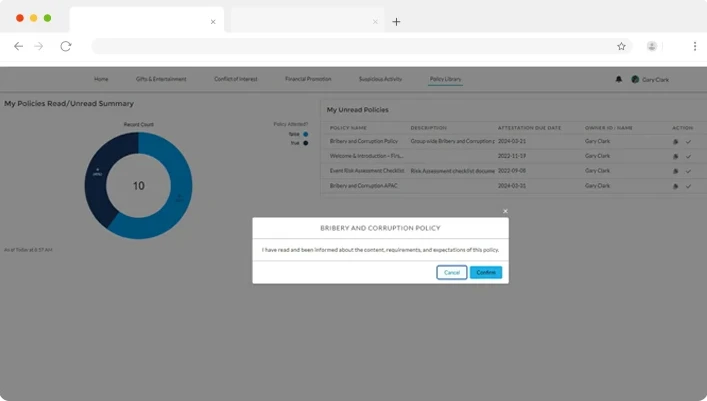
Policy management software demo screen 2

Document All
Policy-Related Activities

Are you exposed to greater liability because you have a mishmash of rogue or out-of-date policies that send conflicting messages about acceptable behaviour? Riskonnect’s Policy Management software layers in out-of-the-box workflows and documents tasks, versions, approvals, and training, so you always know who did what.

  • Monitor exceptions, identify violations, and report on relationships for each policy.
  • Easily submit attestations and exceptions via a portal.
  • Centralise access to policies for easy browsing.
  • Facilitate training by associating questions and quiz elements according to regulatory compliance assessment structure.
  • Validate that respondents understand to what is being attested.

Streamline and Automate

Policy Administration

How much time do you spend tracking down policies and verifying compliance? Riskonnect’s Policy Management software centralizes all key policies, attestations, and exceptions, so everything you need is right at your fingertips.

  • Filter by policy, regulation, domain, vendor, title, owner, and more.
  • Identify areas of with high exceptions and violations.
  • Promote better decision-making with customised dashboards and point-and-click reporting.
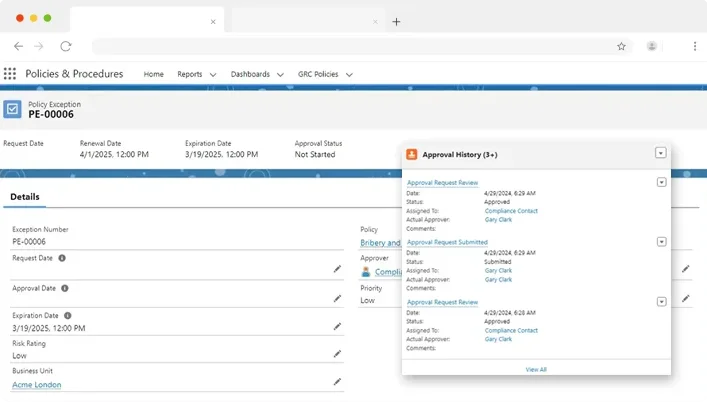
Policy Management Software demo screen 3

Get Started with These Helpful Resources

EBOOK
Transforming Compliance
from Check-the-Box to Champion
This guide will show you how to stay on top of endless regulatory change – and champion the organisation’s future.
Risk management software buying guide
EBOOK
The Complete Guide to
Buying Risk Management Software
This guide demystifies the buying process with step-by-step navigation through the entire journey.
RFP TEMPLATE
Starting an RFP process for
policy management software?
Download Riskonnect’s list of the most critical questions to ask and customise it to suit your needs.

Customers with Enhanced Policy Management Programmes

Also Use

Third-Party
Risk Management
Apply a structured methodology to demonstrate control of AI use – without limiting innovation.
Compliance
Aggregate all corporate and legal policies, procedures, and requirements from across the organisation into one centralised location.
IT Risk
Management
Identify your top IT, cyber, operational resilience, and other technology risks to minimise the financial impact.

Start anywhere. Expand everywhere.

Industry Recognition for Riskonnect

Redhand Advisors Forrester Wheelhouse Advisor

Start partnering with Riskonnect today.
Find out how Riskonnect can transform the way you view risk.

Quick Answers to Your Policy Management Software Questions

Policy management software is a tool to track and administer corporate policies and procedures. It collects all policies, attestations, and exceptions in one location that’s easily accessible to all authorised users.

Riskonnect’s Policy Risk Management software offers a variety of specialised features and functions – like automated review and approval, attestation and training campaigns, violation and issue management, and a policy portal – to simplify the process and ensure consistency across the organisation.

Corporate policies are created for a reason – to manage identified risks. But if expectations are buried in paper documents, local hard drives, or shared files, it can be difficult to enforce the rules about acceptable behaviour, which exposes the organisation to greater liability. One sign that it’s time to consider policy management software is if different locations or departments follow their own standards. Another indicator is if people can’t easily locate the current policy – or if they aren’t aware there is a policy at all. And if leaders are regularly asking for reports and insights that are difficult or impossible to produce, policy management software may be exactly what you need.

Look for policy management software that is easy to use, accessible, reliable, and secure. You should be able to layer in out-of-the-box workflows and document tasks, versions, approvals, and training.

Riskonnect is designed to seamlessly connect risk data of all types across your organisation. We also offer APIs (application programming interface) to easily import and export data and out-of-the-box integrations with specialised partners to help you get the most from your data as efficiently as possible.

Pricing depends on the size and complexity of the project and how much customisation you require. We offer three industry-leading implementation options at different price points to fit your budget, while achieving your business objectives as quickly as possible.

The policy lifecycle is the end-to-end process a policy goes through from creation to retirement: drafting, review, approval, publication, distribution, attestation, periodic review, updating, and eventual archival or retirement. Managing this lifecycle manually — across email chains, shared drives, and spreadsheets — creates version control problems, missed review deadlines, and gaps in the attestation record. Policy management software automates the key handoffs in this process: triggering review cycles on schedule, routing drafts through approval workflows, distributing updated policies to the right people, and capturing acknowledgment. The result is a policy program that runs consistently without requiring manual coordination at every stage. For a deeper look at what this means in practice, see What is Policy Lifecycle Management?

Policy compliance tracking is the process of monitoring whether employees and relevant parties have read, understood, and acknowledged the policies that apply to them — and following up when they haven’t. Without a systematic approach, compliance officers have no reliable way to know whether a policy has been seen, whether training associated with it was completed, or whether any exceptions or violations have been reported. Policy compliance tracking software automates this by capturing attestation responses, recording quiz results, flagging overdue acknowledgments, and generating reports that show compliance status across the organisation. This documentation is also what demonstrates to auditors and regulators that policies aren’t just published — they’re actively enforced.

These terms describe overlapping but distinct capabilities. Compliance document management software focuses on storing, organising, versioning, and retrieving compliance-related documents — it’s primarily a document control and records management function. Policy management software is broader: it encompasses document storage, but adds workflow automation for authoring, review, and approval; distribution and attestation tracking; violation and exception management; and reporting on policy compliance status across the organisation. In practice, most organisations need both functions, and the strongest policy management platforms deliver them in an integrated system rather than requiring separate tools. The key differentiator is whether the software manages the policy as a living, governed object — or just as a file.

The most important capabilities in a policy management platform are: a centralised, cloud-based repository that serves as the single source of truth for all policy documents; version control that maintains a clear history of edits, approvals, and updates; automated workflow routing for review, approval, and attestation campaigns; a self-service policy portal where employees can browse, read, and acknowledge policies without needing to contact the compliance team; violation and exception tracking with follow-up workflows; and configurable dashboards and reporting that let compliance officers and leadership see policy status at a glance. Integration with your broader compliance software and GRC tools — so that policies are connected to the regulations and controls they’re designed to satisfy — is also a strong indicator of a mature platform.

Most compliance errors tied to policy aren’t the result of bad intentions — they’re the result of people following an outdated version of a policy, being unaware a policy exists, or never formally acknowledging it in the first place. Policy management software addresses each of these failure modes directly: version control ensures everyone is working from the current document; automated distribution pushes updates to the right people when policies change; attestation campaigns confirm acknowledgment and comprehension; and violation tracking creates a feedback loop so the compliance team knows where gaps are occurring. The cumulative effect is a policy program that doesn’t rely on individuals to self-manage their compliance obligations — it manages those obligations for them. If you’re unsure whether your current process has these gaps, 10 Signs That Your Policy Management Process Needs an Upgrade is a useful diagnostic.

Policy attestation is the formal process by which employees or other stakeholders confirm that they have read, understood, and agree to comply with a specific policy. It creates a documented record that is critical for demonstrating compliance to auditors, regulators, and legal teams. In policy management software, attestation campaigns are typically automated: the system sends acknowledgment requests on a defined schedule, tracks who has responded and who hasn’t, sends reminders to non-responders, and generates reports showing attestation rates by policy, department, or individual. Some platforms — including Riskonnect — also support quiz-based attestation, where respondents must answer questions to validate comprehension, not just confirm they clicked through.

Policies don’t exist in isolation — they’re typically written to satisfy specific regulatory requirements, control frameworks, or governance standards. When policy management software is integrated with a broader GRC platform, policies can be mapped directly to the regulations, controls, and risk assessments they support. This means that when a regulation changes, it’s immediately visible which policies need to be updated. It also means that compliance evidence — including attestation records and exception logs — is available in the context of the regulatory obligation it’s satisfying, rather than stored in a separate system that auditors have to cross-reference manually. Riskonnect’s Policy Management software is designed to work alongside its Compliance software for exactly this reason.

Any organisation with a significant number of employees, a regulated operating environment, or complex governance requirements benefits from a dedicated policy management platform. In healthcare, HIPAA and patient safety requirements make consistent policy distribution and attestation a compliance necessity — not an operational nicety. Financial services firms manage dense regulatory obligations that require policies to be current, mapped to specific requirements, and demonstrably acknowledged by staff. Manufacturing and energy companies manage safety-critical policies where a lapse in acknowledgment can have serious operational consequences. Public sector organisations face public records and accountability obligations that make an auditable policy management system essential. Even organisations outside traditionally regulated industries benefit when they reach a scale where informal policy management creates inconsistency and liability exposure.

Corporate policy management refers to the governance of organisation-wide policies — codes of conduct, HR policies, ethics standards, data privacy practices, and similar frameworks that apply across the entire business. Operational policy management, by contrast, covers the procedures and standards specific to a particular function, department, or process: a finance team’s expense approval procedures, an IT team’s access control policies, or a manufacturing facility’s safety operating procedures. Good policy management software handles both, with the flexibility to set different ownership, review cycles, distribution audiences, and attestation requirements for different policy types. Riskonnect’s approach to corporate policy management is designed to accommodate this range within a single platform.

The evaluation process should start with an honest assessment of where your current policy program breaks down. Common failure points include: no single authoritative location for policies, inconsistent review and approval processes, no reliable way to know who has read what, and inability to produce attestation records quickly when needed. From there, the key evaluation criteria are: ease of configuration for non-technical users; workflow flexibility to match your existing approval processes; the quality of the employee-facing policy portal; integration with your compliance, risk, and HR systems; and the robustness of reporting and audit trail capabilities. Starting with a structured RFP is the most reliable way to compare options on criteria that matter — Riskonnect’s Policy Management RFP template covers the questions that separate genuine policy compliance software from basic document repositories.