

Business Strategy Software

Riskonnect’s Business Strategy software helps you develop, manage, and execute your strategy, measure ongoing performance, and keep your team working together toward your goals and objectives.

Keep everyone aligned with your goals. Plan and execute strategy projects and related actions from one place.

Measure the effectiveness of strategic planning. Demonstrate how operational initiatives contribute to high-level objectives using a sophisticated KPI engine.

Easily communicate the status of your strategy execution. Keep the C-suite and the board up to date on the status of strategic initiatives with dashboards and reports.
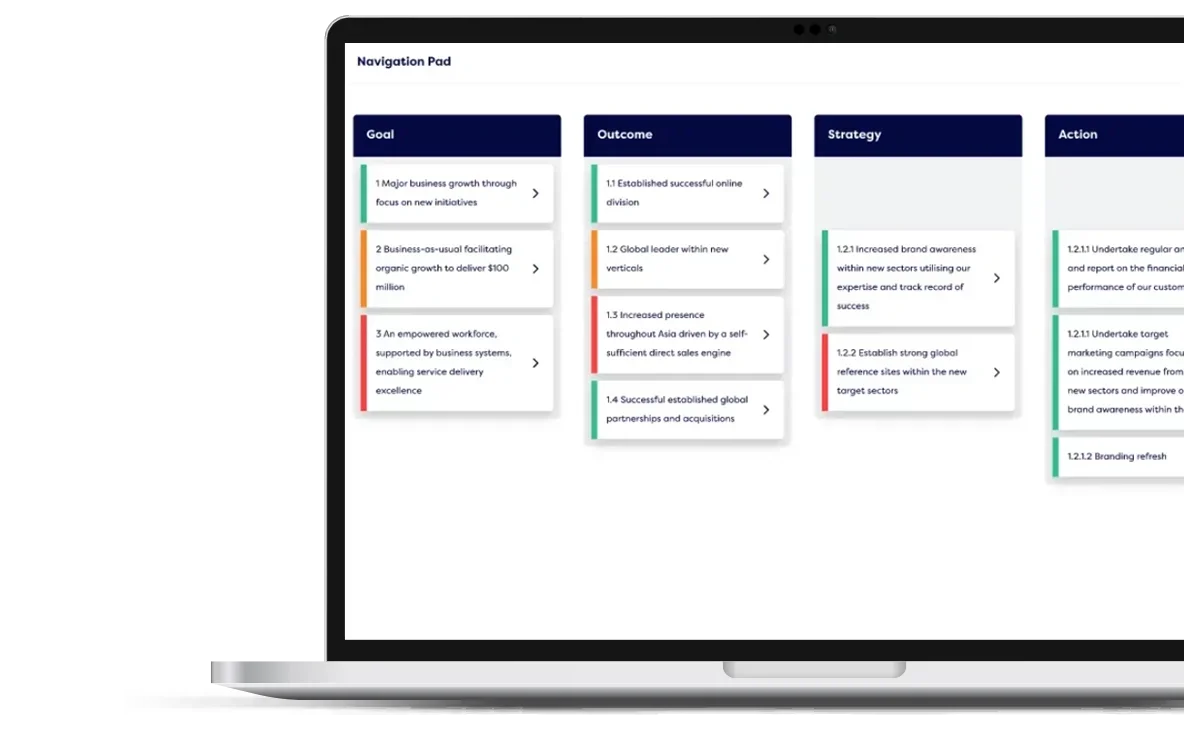
Business Strategy Software on laptop screen

Business Strategy

Software Highlights
  • Board & Executive
    Reporting
    Easily compile executive-level actions and metrics to demonstrate how the strategy is progressing and highlight issues and risks.
  • KPI Reports
    Link your strategic plan to key performance indicators to understand if adjustments are necessary.
  • Scorecards
    Get a quick view of strategic performance to understand your current position.
  • Strategic & Operational
    Planning
    Build out your end-to-end strategic and operational objectives, from top-level goals to daily tasks.
  • Strategic
    Progression
    Get a holistic view of performance at every level of your plan structure.
  • Strategic
    Risk
    Create a strategic risk register, monitor exposure, and set controls to mitigate threats and identify opportunities.
  • Task & Action
    Management
    Establish clear assignments, timelines, and financials, track progress, automatically send alerts to keep things on track.

Business Strategy Software Demo Video

Keep Track of

Everything from One Place

Is there a disconnect between your overall business strategy and the execution? Riskonnect’s Business Strategy software brings together all strategy-related information into one platform to keep everything connected and moving forward.

  • Visualise your end-to-end strategic plan from high-level goals to low-level actions.
  • Break down complex actions into smaller tasks and assign responsibilities.
  • Monitor progress against targets.

Integrate Strategic
Planning with Risk Management

When does a risk become a strategic opportunity? Riskonnect’s Business Strategy software empowers you to take calculated risks when it makes sense in terms of your broader goals.

  • Create a strategic risk register, monitor exposure, and set up controls to mitigate risks and identify opportunities.
  • Drill down into details to investigate metrics or actions that may be off track.
  • Monitor KPIs as evidence of effectiveness.

Communicate

Effortlessly to Leaders

Do you have evidence that your strategic plan is delivering on expectations? Riskonnect’s Business Strategy software provides important evidence of strategy effectiveness to help the C-suite and boards quickly understand if adjustments are necessary.

  • Easily create reports with key actions and metrics most relevant to leaders.
  • Build scorecards that show an aggregated view of strategic performance, priorities, and current position.
  • Gather executive feedback and approvals to stay on track.
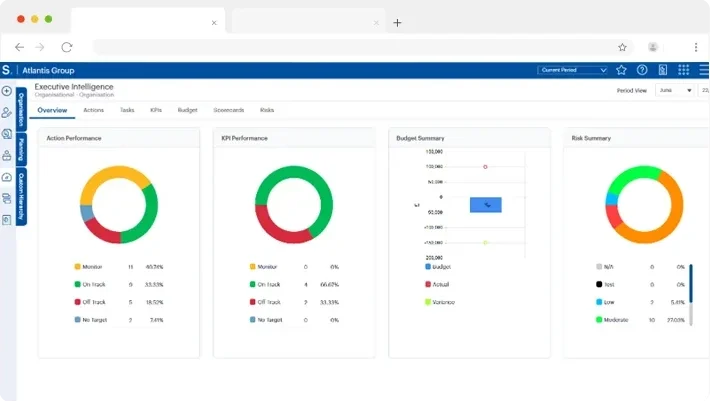
Business Strategy Software demo screen 3

Get Started with These Helpful Resources

EBOOK
Bridging the Gap: Risk
Management and Business Strategy
Misalignment between risk and strategy can cause crippling blind spots that threaten long-term success. This ebook will help you understand the value of a strong connection – and how to make it happen.
WHITE PAPER
The Hunt for
Hidden Risks
Some of the most destructive risks are the hardest to identify. This white paper explains the nature, impact, and mitigation of hidden risks.
RFP TEMPLATE
Starting an RFP
process for GRC software?
Download Riskonnect’s list of the most critical questions on GRC solutions and customise it to suit your needs.

Customers with Enhanced

Business Strategy Programmes Also Use

Enterprise Risk Management
Combine insurable and noninsurable risks so you can anticipate, assess, mitigate, and monitor every threat from every corner of the organisation.
Compliance
Aggregate all corporate and legal policies, procedures, and requirements from across the organisation into one centralised location.
AI Governance
Apply a structured methodology to demonstrate control of AI use – without limiting innovation.

Start anywhere. Expand everywhere.

Industry Recognition for Riskonnect

Redhand Advisors Forrester Wheelhouse Advisor

Start partnering with Riskonnect today.
Find out how Riskonnect can transform the way you view risk.

Your Business Strategy Software Questions Answered

Business strategy software is a platform for developing, documenting, executing, and tracking an organisation’s strategic plan — connecting high-level goals and objectives to the operational initiatives, KPIs, and day-to-day actions that determine whether the strategy succeeds. Where general project management tools focus on task completion, business strategy software keeps the entire organisational hierarchy of goals visible simultaneously: from board-level strategic objectives down through departmental plans and individual assignments. It’s the platform that makes strategy a living, managed discipline rather than an annual planning document that sits on a shelf until next year’s cycle. The primary value is alignment — ensuring that the people doing the work each day understand how their actions connect to the organisation’s most important priorities.

Project management software tracks the execution of discrete projects: scope, tasks, deadlines, resources, and deliverables. Business strategy software operates at a higher level — it manages the strategic plan itself, the objectives that projects serve, and the performance indicators that determine whether the strategy is working. The key distinction is direction: project management tools ask “is this project on track?” while business strategy software asks “is our strategy delivering the outcomes we intended?” In practice, the two are complementary. Riskonnect’s Business Strategy platform manages the strategic planning layer — objectives, KPIs, scorecards, strategic risk — while connecting to operational task and action management so that execution is visible in the context of strategic intent, not separated from it.

A KPI (Key Performance Indicator) engine is the capability that links strategic objectives to the measurable outcomes that indicate whether those objectives are being achieved. In business strategy software, a sophisticated KPI engine does several things: it defines the measurement methodology for each indicator, calculates performance automatically from connected data sources, tracks trends over time, flags indicators that are off track against targets, and rolls up KPI performance into the scorecards and dashboards that leadership uses to assess strategic progress. The value of a KPI engine isn’t just measurement — it’s the ability to trace performance back to specific initiatives and actions so that leaders can understand what’s driving results and where course corrections are needed. Riskonnect’s platform includes a KPI engine specifically designed to demonstrate how operational-level initiatives contribute to high-level strategic objectives.

A strategic risk register is a structured record of the risks that could prevent an organisation from achieving its strategic objectives — not operational or compliance risks in isolation, but risks evaluated specifically through the lens of strategic impact and opportunity. Most organisations maintain separate risk registers for operational, financial, and compliance risks, but strategic risks — the threats and opportunities that affect whether the strategy itself succeeds — often live outside those frameworks or aren’t connected to the goals they affect. Embedding a strategic risk register directly in business strategy software closes this gap: every strategic objective has an associated risk picture, every risk has a linked control or mitigation, and leaders can see at a glance whether the risks to their most important strategic priorities are being managed. This integration of strategy and risk is one of the most meaningful differentiators of Riskonnect’s approach — for a deeper look at why it matters, see the Bridging the Gap: Risk Management and Business Strategy ebook.

OKRs (Objectives and Key Results) and KPIs (Key Performance Indicators) are both goal-setting tools, but they serve different purposes. KPIs are measures of ongoing performance — they track how a function or process is performing against an established standard, often on a continuous basis. OKRs are time-bounded goal-setting frameworks: an Objective defines a qualitative ambition (“become the market leader in customer satisfaction”), and Key Results define specific, measurable outcomes that would indicate the objective has been achieved within a defined period. OKRs tend to drive stretch goals and cross-functional alignment; KPIs tend to maintain performance standards. Good business strategy software accommodates both — supporting the aspirational, time-bounded structure of OKRs for major strategic initiatives while maintaining the ongoing KPI reporting that keeps operations and leadership informed.

Strategic progression tracking is the capability to monitor the status of a strategic plan at every level of its hierarchy simultaneously — from board-level objectives through divisional goals, departmental programmes, and individual actions — and to understand how performance at each level contributes to or threatens performance at the level above it. In practice, this means a CEO can view a top-level strategic scorecard and drill down through each objective to see which initiatives are on track, which are lagging, and why — without waiting for a quarterly board report that’s already several weeks out of date. Riskonnect’s Business Strategy software provides this holistic progression view in real time, with dashboards and scorecards that surface the right level of detail for each audience: strategic summary for the board, operational detail for department heads, and task-level clarity for project owners.

A scorecard is a visual summary of strategic performance that aggregates KPIs, initiative status, and risk indicators into a consolidated view calibrated to a specific audience — typically a business unit, a geographic region, a strategic theme, or the organisation as a whole. Scorecards translate the complexity of a multi-level strategic plan into a readable, at-a-glance format that gives executives and board members the information they need to assess overall direction and flag items that need attention — without requiring them to navigate detailed operational reports. In Riskonnect’s platform, scorecards are built from live data and can be configured to reflect the specific priorities and metrics most relevant to each leadership audience, updated automatically as underlying data changes rather than requiring manual compilation before each reporting cycle.

Strategy and risk are inseparable in practice: every strategic choice involves accepting certain risks in pursuit of certain opportunities, and the risks an organisation manages should ultimately be evaluated through the lens of their impact on strategic objectives. Yet in most organisations, strategic planning and risk management happen in separate processes with separate tools and separate conversations. When business strategy software and enterprise risk management share the same platform, that separation disappears: strategic objectives have associated risk registers, risk events are evaluated for their strategic impact, and KPI underperformance can trigger risk assessment workflows rather than just generating a red indicator on a dashboard. Riskonnect is designed specifically for this integration — business strategy and ERM share the same environment, so risk informs strategy execution rather than reporting in parallel to it.

Any organisation that develops a multi-year strategic plan and needs to execute it across multiple departments, business units, or geographies benefits from dedicated strategy software. The need is most acute for organisations where the gap between strategic intent and operational execution is a recurring problem — where annual plans are created but rarely tracked systematically between planning cycles, or where leadership lacks real-time visibility into whether strategic initiatives are delivering results. Organisations in regulated industries benefit additionally from the ability to connect strategic objectives to compliance and risk programmes. The platform is particularly valuable for organisations that want to move from strategy as an annual event to strategy as an ongoing, data-driven discipline — effective strategic planning in healthcare and effective strategy execution in education illustrate how this plays out across different sectors.

Evaluating business strategy software should start with clarity about your primary pain point: Is it the planning process itself (building a structured, hierarchical strategic plan), the execution tracking (monitoring progress against objectives in real time), the KPI and performance measurement capability, the ability to connect strategy to risk, or the reporting to leadership and boards? Different platforms have different strengths across these dimensions. Key evaluation criteria for leading business strategy platforms include: depth of goal hierarchy and OKR/KPI management; quality of scorecard and dashboard reporting for executive audiences; strategic risk register capability and its connection to the broader risk program; ease of use for contributors across the organisation who are not strategic planning specialists; and integration with the GRC, compliance, and ERM programmes that strategic risk decisions affect. The GRC RFP template covers the broader set of questions relevant to Riskonnect’s integrated approach — a useful starting point for organisations evaluating strategy alongside risk and compliance.