
ESG Software

Environmental, Social, and Governance

Riskonnect’s ESG software simplifies ESG data collection, analysis, and reporting across your organisation and supply chain.

Centralise your ESG data. Collect investor-grade information from sites and suppliers to identify regulatory, physical, and continuity risk exposures.

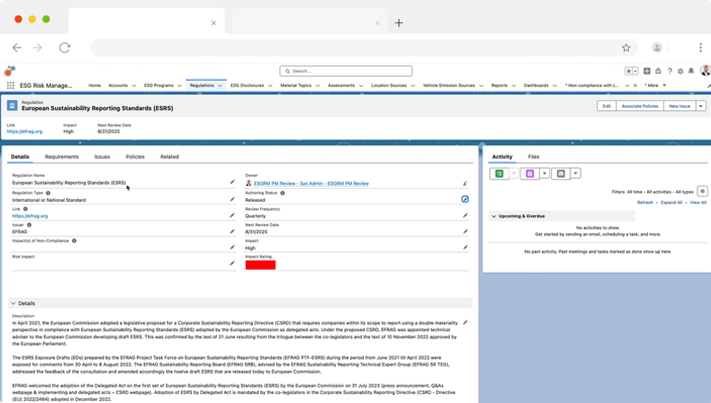
Manage regulatory compliance obligations with ease. Align with up-to-date reporting requirements for frameworks and regulations, such as SASB, ESRS (CSRD), and UN SDGs, to facilitate disclosures.

Know your ESG risks in your supply chain. Monitor your operations to detect and eliminate risks with real-time insights, alerts, and controls.
ESG Software

ESG Software

Product Highlights

  • Audit Management
    Manage supplier audits and site inspections with integrated corrective and preventative actions management (CAPA) and reporting.
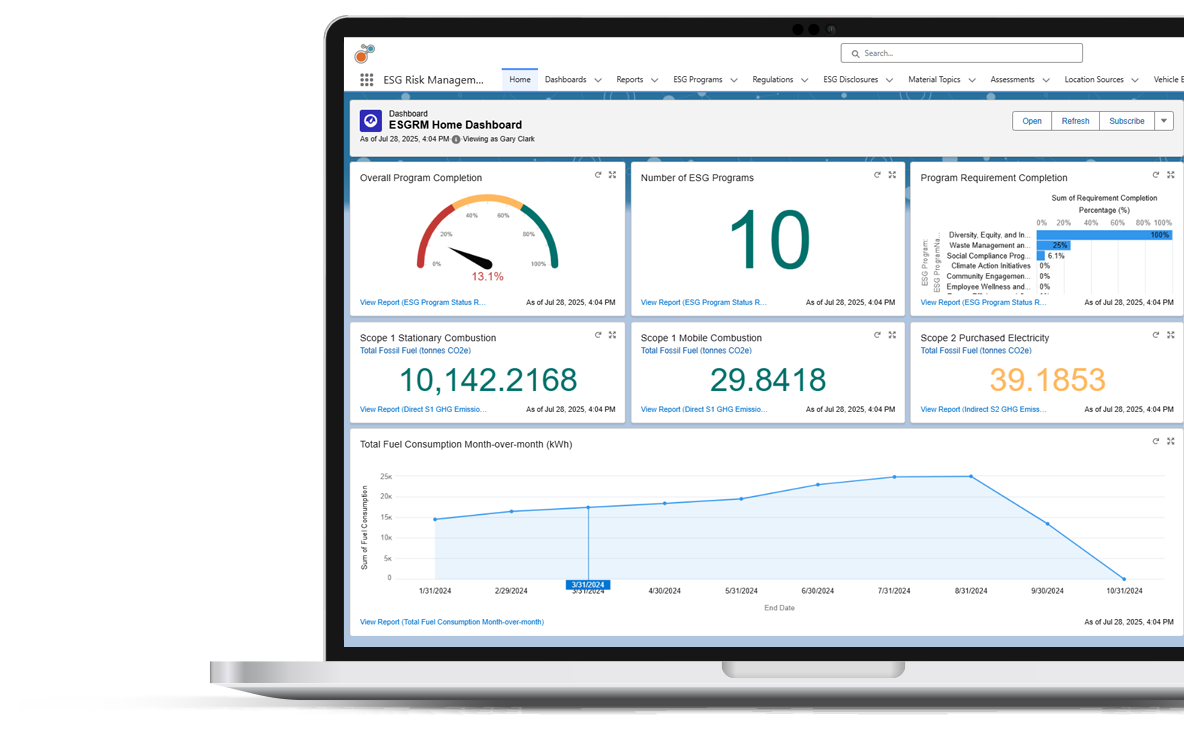
  • Dashboards
    Use intuitive dashboard design tools backed by powerful analytics to provide insights and collaboration for better decisions around your ESG performance.
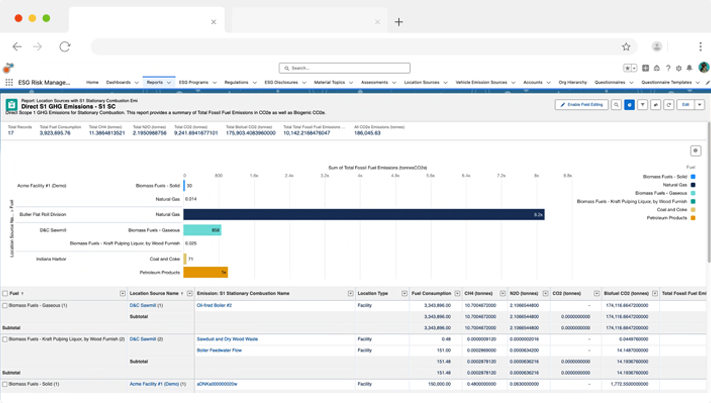
  • GHG Emissions
    Calculations
    Capture data, determine emissions, and manage the carbon footprint of your operations and supply chains.
  • Materiality Assessments
    Identify ESG issues that are most important to your organization to guide program development.
  • Program Management
    Develop objectives and capture disclosure details in context of regulatory and framework requirements.
  • Reporting and Analytics
    Easily customize your reporting and dashboards to tell your story and inform decisions.

Make ESG Reporting Easy

Intimidated by the sheer volume of data, people, and systems needed to create ESG reports? Riskonnect’s ESG software automatically captures data in line with ESG reporting standards, disclosure requirements, and frameworks.

  • Collect investor-grade data from your sites and suppliers.
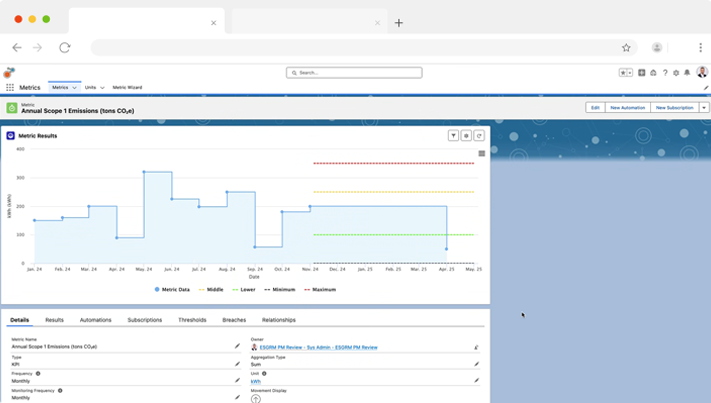
  • Track ESG risks and performance in real time.
  • Streamline reporting operations with ESG standards-based data-collection forms.
Get Better Visibility
into Your Supply Chain

Are your suppliers exposing you to unexpected ESG risks? Riskonnect’s ESG software provides real-time visibility into ESG risks across your network of supply-chain partners to prevent unwanted surprises.

  • Map supplier relationships and connected risks.
  • Identify regulatory, physical, and continuity risk exposures in your supply base.
  • Monitor risk with real-time alerts based on configurable thresholds.
  • Increase compliance in your supply base and optimise performance with benchmarking and peer comparisons.

Tell Your ESG

Story with Credibility

Can you meet stakeholder demands – from investors, customers, employees, and more – for ESG transparency and accountability? Riskonnect’s ESG software pulls together all relevant information from wherever it currently resides into a cohesive ESG narrative that aligns with your values and strategy, as well as industry practices.

  • Centralise all your ESG initiatives in one place.
  • Detect and manage ESG risk with artificial intelligence, integrated analytics, and customizable scoring.
  • Communicate transparently with stakeholders on your ESG performance and progress.
Get Started with These Helpful Resources


EBOOK
Taking a Stand on ESG
This ebook explains what ESG is, what the risks are, and how to begin reporting so you can prepare now for what may be headed your way.
CALCULATOR
Calculate Your ROI
for ESG Software
Take 5 minutes and answer 3 questions to find out how much you could save with Riskonnect’s ESG software.
RFP TEMPLATE
Starting an RFP process for
ESG reporting software?
Download Riskonnect’s list of the most critical ESG-related questions and customise it to suit your needs.

Customers with Enhanced

ESG Programmes Also Use

Third-Party
Risk Management
Collect all vendor information – including agreements, contracts, policies, and access credentials – into one place to efficiently monitor suppliers throughout the entire relationship.
Compliance
Aggregate all corporate and legal policies, procedures, and requirements from across the organisation into one centralised location.
Enterprise
Risk Management
Combine insurable and noninsurable risks so you can anticipate, assess, mitigate, and monitor every threat from every corner of the organisation.

Start anywhere. Expand everywhere.

Industry Recognition for Riskonnect

Redhand Advisors Forrester Wheelhouse Advisor

Start partnering with Riskonnect today.
Find out how Riskonnect can transform the way you view risk.

Quick Answers to Your ESG Software Questions

ESG software is a tool to simplify environmental, social, and governance data collection, analysis, and reporting. It collects and tracks Scope 1, 2, and 3 emissions data from the organisation and throughout the supply chain to facilitate compliance. Technology also adds consistency in tracking metrics over time.

Riskonnect’s ESG software offers a variety of specialised features and functions – like reporting templates, greenhouse gas emissions calculation, supplier scorecards, and audit management – to automate data capture, streamline reporting, and communicate transparently.

Demand for ESG-related information is high, but providing that information can be a challenge – especially for Scope 3 emissions. Tracking, say, carbon emissions from your suppliers, their suppliers, their suppliers, all the way down the line can generate more data than a human can handle. And it is not a one-and-done exercise. One sign that you need ESG software is if you are struggling to comply with regulatory requirements. And if investors, customers, regulators, leaders, and other stakeholders are regularly asking for reports and insights that are difficult or impossible to produce, ESG software may be exactly what you need.

Look for ESG software that can collect data from your organisation and through your entire supply chain. The software should be easy to use, accessible, reliable, and secure.

Riskonnect is designed to seamlessly connect risk data of all types across your organisation. We also offer APIs to easily import and export data and out-of-the-box integrations with specialised partners to help you get the most from your data as efficiently as possible.

Pricing depends on the size and complexity of the project and how much customisation you require. We offer three industry-leading implementation options at different price points to fit your budget, while achieving your business objectives as quickly as possible.

ESG stands for Environmental, Social, and Governance — the three dimensions used to evaluate an organisation’s performance and impact beyond financial returns. The environmental dimension covers how the organisation manages its relationship with the natural world: carbon emissions, energy use, water consumption, waste, and climate-related risk. The social dimension covers the organisation’s impact on people: employee safety and wellbeing, labour practices, supply chain conditions, community relationships, and diversity and inclusion. The governance dimension covers how the organisation is led and held accountable: board composition, executive pay, anti-corruption practices, transparency, and shareholder rights. Together, these factors give investors, regulators, customers, and other stakeholders a more complete picture of an organisation’s long-term viability and trustworthiness than financial metrics alone. For a deeper look at why ESG has become so central to corporate strategy, see ESG Sustainability: More Than Going Green.

Greenhouse gas emissions are classified into three scopes under the GHG Protocol — the most widely used accounting standard for emissions reporting. Scope 1 covers direct emissions from sources owned or controlled by the organisation, such as fuel combustion in owned vehicles and facilities. Scope 2 covers indirect emissions from purchased energy — primarily electricity and heat. Scope 3 covers all other indirect emissions in the value chain, including those from purchased goods and services, business travel, employee commuting, product use, and end-of-life treatment of sold products — and it typically represents the largest share of most organisations’ total footprint. Scope 3 is also by far the most difficult to measure: it requires collecting data from hundreds or thousands of suppliers, each with their own data systems and reporting practices. ESG software is essentially indispensable for Scope 3 because no manual process can reliably collect, validate, and aggregate that volume of data at the frequency required for accurate reporting.

The ESG regulatory and framework landscape is one of the most complex in the corporate reporting world, and it’s still evolving rapidly. The major voluntary frameworks include GRI (Global Reporting Initiative) — the most widely used standard globally for sustainability disclosures; SASB (Sustainability Accounting Standards Board) — which provides industry-specific metrics; and TCFD (Task Force on Climate-related Financial Disclosures) — focused on climate risk and opportunity. On the mandatory regulatory side, the EU’s CSRD (Corporate Sustainability Reporting Directive) and its associated ESRS (European Sustainability Reporting Standards) are the most significant development in recent years, extending mandatory sustainability reporting to a much wider range of companies. UN SDGs provide an internationally recognised goal framework that many organisations use to contextualise their ESG programmes. Riskonnect’s platform aligns with SASB, ESRS/CSRD, and UN SDGs out of the box, and is designed to accommodate the evolving regulatory landscape. For guidance on navigating the framework options, see How to Choose an ESG Framework.

A materiality assessment is the process of identifying which ESG issues are most significant to both the organisation’s business performance and its stakeholders — determining where to focus the program, what to measure, and what to disclose. Different industries face different material ESG issues: carbon emissions may be highly material for an energy company but less so for a software business, while data privacy may be material for a financial services firm in a way it isn’t for a manufacturer. ESG software supports materiality assessments by providing structured templates and scoring tools that capture input from internal and external stakeholders, map issues against regulatory requirements and peer practices, and produce a prioritised view of the ESG topics that should anchor the program. Starting a program without a materiality assessment risks spending resources measuring and reporting on issues that don’t actually matter to the organisation or its stakeholders.

Supply chain ESG risk is one of the most challenging aspects of any ESG program — and increasingly one of the most scrutinised by regulators and investors. CSRD, the EU’s CSDDD (Corporate Sustainability Due Diligence Directive), and similar regulations require organisations to assess and address ESG risks not just in their own operations but throughout their value chains. ESG software supports supply chain risk management by enabling supplier questionnaires and self-assessments at scale, tracking compliance across large and geographically dispersed supplier bases, triggering alerts when supplier risk indicators cross defined thresholds, and benchmarking supplier performance against peers. Riskonnect’s ESG software extends this further by connecting supply chain ESG data to the organisation’s third-party risk management program — so ESG risk in the supply chain is visible alongside other vendor risks rather than managed in a separate system.

Carbon accounting platforms are specialised tools focused primarily on measuring, tracking, and reporting greenhouse gas emissions — typically Scope 1, 2, and 3 — and often include features for carbon offsetting and net-zero pathway modelling. ESG software is broader: it encompasses emissions tracking but also manages the full range of social and governance metrics, regulatory framework compliance across multiple standards simultaneously, supply chain ESG risk, stakeholder engagement, materiality assessments, and audit management. Organisations with a narrow focus on emissions reporting may find a carbon accounting platform sufficient, but organisations that need to comply with CSRD, respond to investor ESG questionnaires, manage supply chain ESG risk, and produce disclosures across multiple frameworks will typically need the full capability of a dedicated ESG platform. The right choice depends on the scope of the program and the regulatory obligations the organisation faces.

GHG (greenhouse gas) emissions calculation involves collecting activity data — energy bills, fuel consumption, travel records, supply chain volumes, waste data, and more — applying the appropriate emission factors for each activity type and geography, and aggregating the results into Scope 1, 2, and 3 totals in a format that satisfies regulatory and framework disclosure requirements. ESG software automates this process by providing structured data collection forms aligned to the required inputs for each emissions category, applying up-to-date emission factors from authoritative sources, calculating emissions automatically as data is entered, and generating the formatted outputs needed for CSRD, GHG Protocol, and other reporting standards. Manual GHG calculation at scale — particularly for Scope 3 — is an enormous administrative burden that ESG software eliminates, while also reducing the risk of calculation errors that can undermine the credibility of disclosed figures.

ESG risk doesn’t exist in isolation from an organisation’s other risk and compliance obligations. Climate-related physical risks affect business continuity. Supply chain ESG failures create reputational and regulatory exposure. Governance shortcomings surface in both ESG reports and compliance audits. When ESG software is connected to the broader GRC platform, ESG risk data can inform the enterprise risk register, ESG compliance obligations can be managed alongside other regulatory requirements in the compliance program, and supply chain ESG assessments can feed into the TPRM workflow. Riskonnect is built for this integration — ESG, compliance, ERM, and TPRM share the same platform environment, so the organisation gets a unified view of its exposure rather than an ESG program that operates independently of how the rest of the business manages risk.

ESG audits are assessments of an organisation’s sustainability practices, data quality, and reporting accuracy — conducted internally as part of program governance, or by external parties such as third-party assurance providers, investors, or regulators. As ESG disclosure requirements become more demanding — particularly under CSRD, which requires third-party assurance of sustainability reports — the quality of the underlying data and the completeness of the audit trail supporting it have become increasingly important. ESG software supports audit readiness by maintaining a documented record of data collection, calculation methodologies, framework mappings, and corrective actions; enabling supplier audits with integrated CAPA management for identified gaps; and generating the self-assessment and reporting artifacts that auditors and assurance providers require. Riskonnect’s audit management capability is built into the ESG software rather than requiring a separate tool.

ESG software evaluation should start with clarity about your primary use case: Is the immediate driver regulatory compliance (CSRD, TCFD), investor reporting, supply chain risk management, or internal sustainability management? Different platforms optimise for different parts of this landscape. Key criteria for leading ESG platforms include: out-of-the-box alignment with the specific frameworks and regulations you must comply with; supply chain data collection capabilities at the scale your vendor base requires; quality of GHG emissions calculation and Scope 3 tracking; integration with other enterprise systems where ESG data originates; audit management and assurance support; and how the platform connects to your broader risk, compliance, and TPRM programmes. Riskonnect’s ESG RFP template provides a structured set of evaluation questions for assessing top ESG platforms — and the ESG Reporting Definitive Guide covers the full landscape of frameworks, regulations, and best practices that inform good software selection decisions.