

Emergency Notification Software

Riskonnect’s Emergency Notification software helps you disseminate timely and effective communications to protect your people and operations throughout the course of a crisis.

Reach the right people at the right time. Push tailored messages to geographic locations, facilities, teams, roles, and more.

Maintain communication no matter what. Access a backup channel if your primary communication channels are disrupted during an emergency or corrupted in a cyber event.

Reduce the administrative burden. Centralise readiness and response activities in one platform.
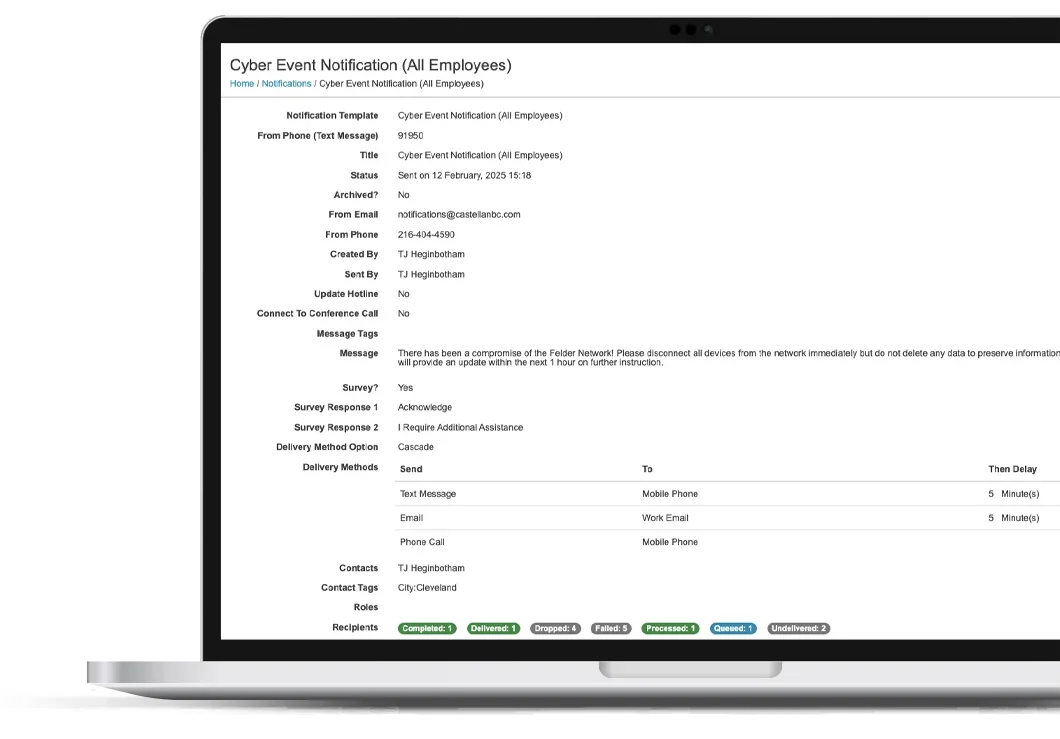
Emergency Notification Software dashboard on laptop screen

Emergency Notification Software

Product Highlights

  • Mobile Emergency
    Communications
    Draft and send new messages, view sent messages, and track delivery and response status from anywhere.
  • Multichannel
    Alerts
    Deliver communications via voice, email, SMS, Teams, and WhatsApp.
  • Message
    Templating
    Save valuable time with communication holding statements and templated messaging.
  • Recipient
    Surveys
    Send surveys to employees and launch reminder notifications to verify safety and engagement.
  • Global
    Scalability
    Quickly reach audiences of any size anywhere in the world.
  • Dashboards
    Track message delivery and summarize survey responses in real time.
  • Interactive Maps
    and Geofencing
    Send location-based alerts and monitor people, threats, and messages in interactive map layers.


Riskonnect is so easy to understand, and the mobile app and single sign-on capabilities offer a huge advantage. When everything is hitting the fan, the last thing you want to do is wrestle with your system. Even if the power is out, we still have the plans in our pockets.

Doug Fleming Senior Director of Environmental, Health, Safety, Business Continuity, and Sustainability, Bio-Rad

Riskonnect integrates emergency notifications directly into the Business
Continuity & Resilience solution through partnerships with leading providers.

AlertMedia
Everbridge

Keep Everyone

in the Loop

Can you reach the right people exactly when you need to? Riskonnect’s Emergency Notification software helps you expertly communicate with your people, teams, and other stakeholders during a crisis or incident.

  • Send targeted notifications to the right people using contact tags that group your people by any criteria such as department or seniority.
  • Record the status and safety of your employees with easy-to-use survey response features.
  • Schedule notifications to ensure timely communication if you have people working in different parts of the world or want to deliver updates at a particular time inside or outside work hours.
Maintain the
Flow of Information


Are you able to collaborate with ease and precision? Riskonnect’s Emergency Notification software helps you spread responsibility among your crisis management team and put the right information at everyone’s fingertips.

  • Decentralise the process of sending notifications by allowing plan owners or their proxies to communicate directly with those named in a specific plan.
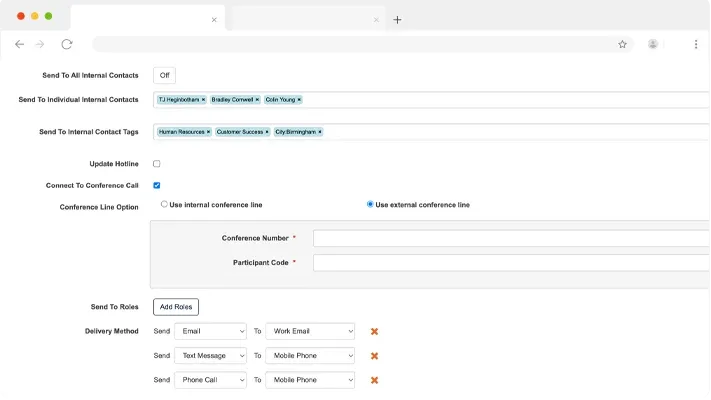
  • Collaborate with team members by adding a conference bridge to your message using the native, internal conferencing platform – or enter the details of the external conferencing platform of your choice.
  • Dynamically and automatically mirror contact information with IT and human resources systems to ensure contact information is accurate.

Understand the Effectiveness

of Your Communications

Can you evaluate the success of your incident management program – and report the results to leadership? Riskonnect’s Emergency Notification software offers helpful dashboards that provide detail on the success of your communications.

  • Summarise delivery status and survey response details with the performance dashboard.
  • Pinpoint which sending methods are most successful for reaching your audience.
  • Resend survey notifications to recipients who have not yet replied to increase response rates.

Get Started with These Helpful Resources

EBOOK
Your Guide to
Cyber Resilience
Cybercrime is one of the biggest threats to any business in any industry. This ebook explains what a comprehensive cyber resilience plan is, what’s at stake, and how to strengthen your approach.
GUIDE
The Complete Guide to Buying
Business Continuity Software
This guide demystifies the buying process with step-by-step navigation through the entire journey to help you find the best fit for your organisation.
RFP TEMPLATE
Starting an RFP process for business continuity and crisis management software?
Download Riskonnect’s list of the most critical Business Continuity & Resilience-related questions and customise it to suit your needs.

Complete Your Resilience Program

with Other Riskonnect Solutions

Enterprise Risk
Management
Combine insurable and noninsurable risks so you can anticipate, assess, mitigate, and monitor every threat from every corner of the organisation.
Third-Party
Risk Management
Collect all vendor information – including agreements, contracts, policies, and access credentials – into one place to efficiently monitor suppliers throughout the entire relationship.
Business Continuity
Management
Conduct business impact analyses, engage stakeholders, comply with regulations, and continuously improve your readiness.

Start anywhere. Expand everywhere.

Industry Recognition for Riskonnect

Redhand Advisors Forrester Wheelhouse Advisor

Start partnering with Riskonnect today.
Find out how Riskonnect can transform the way you view risk.

Your Emergency Notification Software Questions Answered

Emergency notification software is a platform for rapidly disseminating targeted communications to employees, response teams, and other stakeholders during a crisis, disruption, or time-sensitive incident. It enables organisations to send alerts across multiple channels simultaneously — SMS, voice calls, email, mobile app, Microsoft Teams, WhatsApp, and desktop alerts — so that the right people receive critical information regardless of where they are or which devices they’re using. The core value is speed and reach: in an emergency, the ability to contact thousands of people in seconds, confirm receipt, and track response status can be the difference between an orderly response and a chaotic one.

The terms are largely interchangeable in practice, though they emphasise different aspects of the same capability. “Mass notification system” tends to emphasise scale and broadcast reach — the ability to send a message to a very large audience simultaneously, as in a campus-wide alert or a city-wide emergency communication. “Emergency notification software” tends to emphasise the organisational and operational context — the ability to target specific groups, track delivery and response, integrate with crisis management workflows, and maintain an audit trail of who was notified and when. In enterprise business continuity and crisis management contexts, the operational features matter as much as the broadcast capability: knowing that your CFO received and acknowledged an alert is just as important as sending it.

Top emergency notification platforms deliver communications across a range of channels to maximise the likelihood that messages reach recipients even when some channels are unavailable. The standard set includes SMS text messaging, voice calls, email, and push notifications via mobile app. Enterprise-grade platforms extend this to collaboration tools — including Microsoft Teams and WhatsApp — as well as desktop alerts for office-based employees. The multi-channel approach matters because no single channel is universally reliable during a crisis: a cyberattack may compromise email, a power outage may affect desk phones, and remote workers may not see desktop alerts. Riskonnect’s emergency notification capability is specifically designed to provide a backup communication channel if primary channels are disrupted, including during cyber events.

Geofencing is the capability to send location-based alerts to people within a defined geographic boundary — for example, notifying all employees at a specific facility, all personnel within a defined radius of an incident, or all travellers currently in a region experiencing a security threat. In emergency notification software, geofencing works by comparing recipient location data against the defined perimeter in real time and sending targeted alerts to those inside it. This capability is particularly valuable for organisations with distributed workforces, multiple facilities, or employees who travel — it eliminates the manual effort of building recipient lists for location-specific events and ensures that people outside the affected area don’t receive alerts that create unnecessary alarm. Riskonnect’s platform includes interactive maps and geofencing tools that allow organisations to monitor people, threats, and sent messages in layered map views.

Emergency notification is most effective when it’s embedded in the broader crisis management and business continuity response workflow rather than operating as a standalone tool. When notification software is integrated with a business continuity platform, activating a continuity plan can automatically trigger the appropriate notification to the response team — without requiring a separate login or manual message drafting under pressure. Response status tracking feeds back into the incident management workflow, so crisis coordinators can see in real time who is confirmed safe, who has acknowledged their role, and who still needs to be reached. Riskonnect’s emergency notification capability is built directly into its Business Continuity & Resilience platform, so activation, notification, and response coordination all happen in the same environment.

A recipient survey is a two-way communication feature that allows organisations to send a notification and simultaneously request a response from recipients — for example, confirming safety status (“Are you safe? Reply YES or NO”), verifying location, or confirming receipt of instructions. During an emergency, knowing who has responded and what their status is can be operationally critical: it helps crisis managers identify who needs follow-up, track the safety of employees in affected areas, and make resource allocation decisions based on current information rather than assumptions. Riskonnect’s platform includes recipient survey functionality with real-time dashboard tracking of response rates and a resend capability for recipients who haven’t yet replied — ensuring organisations can achieve high confirmation rates even when some recipients are slow to respond.

Outdated contact information is one of the most common points of failure in emergency notification systems — a perfectly designed notification that goes to a deactivated phone number or an old email address achieves nothing. Top emergency notification platforms address this by integrating dynamically with HR and IT systems so that contact records are automatically updated when employees join, leave, or change roles. Riskonnect’s platform mirrors contact information with HR and IT systems in real time, eliminating the manual synchronisation process that creates gaps. For distributed or multi-facility organisations, the ability to segment and tag contacts by location, department, role, and other criteria — and keep those tags current automatically — is as important as the notification delivery capability itself.

Any organisation with a responsibility for people safety, operational continuity, or time-sensitive communication during a disruption can benefit from emergency notification software. The most common users include large employers with distributed workforces who need to reach employees across multiple locations and time zones simultaneously; organisations with regulatory obligations around employee safety notification — including healthcare facilities, manufacturers, and financial institutions; universities and school districts that need to alert students, faculty, and staff to campus threats; and organisations in high-risk industries such as energy, utilities, and critical infrastructure where operational incidents require rapid multi-team coordination. Size matters less than complexity: any organisation that cannot reliably reach all the right people through a single channel during a crisis needs a dedicated notification platform.

Emergency notification is the communications layer of crisis management — it ensures that the right people are informed and coordinated throughout the response to an incident. But it’s most effective when it functions as part of a coordinated crisis management workflow rather than a parallel system. When notification and crisis management share the same platform, the same team that activates a response plan can simultaneously trigger targeted alerts to response team members, track acknowledgment in real time, add conference bridge details to the notification for immediate coordination calls, and maintain a complete record of all communications sent during the incident. This integration eliminates the context-switching that slows response time when notification and incident management are handled in separate tools.

The evaluation should start with your primary use cases: Is the critical capability broadcast speed at scale, targeted group notification, two-way status confirmation, or integration with existing crisis management workflows? Different platforms optimise for different combinations of these. Key selection criteria for leading emergency notification platforms include: channel breadth and reliability across SMS, voice, email, and collaboration tools; geofencing and location-based targeting capabilities; integration with HR and IT systems for automatic contact maintenance; two-way communication and survey response tracking; mobile accessibility for sending and monitoring from any device; integration with crisis management and business continuity platforms; and backup channel availability if primary systems are compromised. Riskonnect’s BCM and crisis management RFP template covers emergency notification requirements alongside the broader resilience program evaluation — a useful starting point for organisations assessing the full response capability they need.